How Does Real Tea Inspire An American? A Conversation With Tony Gebely, Over A Cuppa – 28 Mins
With Tony Gebely
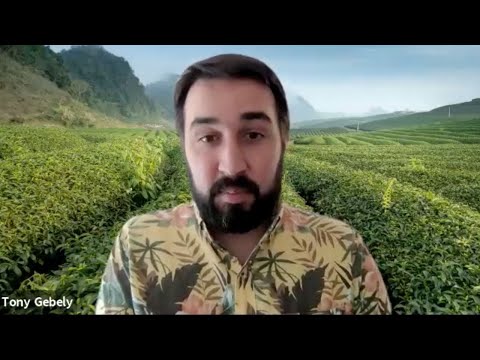
About this episode
Dilhan chats with American author and tea aficionado, Tony Gebely on tea, and the philosophy and politics of tea
Transcript
This transcript was created automatically from the audio and checked for names. Minor errors may remain.
Over a Cuppa with Dilhan Fernando, Tony, wonderful to have you on Over a Cuppa and I'm glad that you're having a cuppa. Tell me what's in your cuppa tea today. This is Silver Tips from Lumbini. Fantastic. That's beautiful. So it's a Ceylon tea and that's good because today is actually a pretty special day for Sri Lanka. We are celebrating, of course, it's the passing but actually the 129th anniversary of the passing of James Taylor, who, you know, to be the father of Ceylon tea. I didn't know that, wow. So I have a few questions for you and I've been particularly anticipating this conversation because Tony, you've done, you've written some incredible books I love, I've read too, I love your blog and your rankings and some beautiful things you do but most important thing I wanted to ask you or rather the first thing I wanted to ask you, what in tea inspired you as an American, your countrymen generally prefer coffee or sweet iced tea?
So tell us. Yeah, it's been a journey, let's say that. I was doing some programming work, I have a computer science background for my university, Rowan University in New Jersey and I was doing particularly work for the International Center and whenever they had an extra trip, you know, like spots on a trip, they would offer them to the workers of the International Center and they approached me with a one month trip to China. They had a couple extra spots on the trip and they said, hey, do you want to go on this trip? The university is paying for most of it. It's actually part of the geology club and there would be coursework every night on the topic of geology that would be optional for you.
I said, sure, I'd love to go to China. Let's do this. So that's really when I first was introduced to tea. It was a couple of years before the Puerh boom in China and before that I was not really too familiar with loose leaf tea and what really struck me about tea was the diversity of taste that you can have from this one ingredient. The processing methods make it into so many different tastes and the terroir and that just really blew my mind. People really get nerdy about wine and coffee for those same traits, but it really wasn't seen in the United States as something that was diverse.
Most Americans drink, if they do drink tea at all, it's going to be black tea from tea bags, which is the least diverse on the taste spectrum that you can pretty much get with tea back then, certainly. Now things have changed a little bit, but yeah, that's what really captivated me about it and started the journey. I think that's what I really love about your blog and also about your book because whilst America refers to tea in the sense of designs and teas that are not necessarily from camellia sinensis, I love the fact that in your book and in your blog, you focus on realty. Tell me, what is it about realty, the terroir and everything you write about that you find so intriguing?
Yeah, I could talk about that for hours really. It starts with that diversity of taste and flavor. Talking about how all of the different natural flavors I'm talking like that come just from the camellia sinensis, learning how they're produced and how these different flavor components arise was really interesting to me. I read a lot of scientific studies about this topic and it just captivated me really. Then to take things a little bit deeper, once you learn about the culture behind tea in basically every other nation except for the United States, especially in tea producing nations, you can spend lifetimes just exploring tea production, tea culture, tea history, not just China everywhere.
When I traveled to Sri Lanka for the 150th anniversary of Ceylon Tea in 2017, I knew very little of the history and culture behind it, let alone the way that tea is produced in Sri Lanka using the small holder system. So many people in Sri Lanka are involved in tea production in some way, it just blew my mind. You don't really know that story that's behind a tea bag or your cup of tea when you're drinking in America, you respond to the branding from the company that's selling it. Sometimes they'll tell the story, not all the time. I kept digging and digging and digging and learning more and more and more.
Really, when I say tea, my tea experience is a journey, it really has been such. To be offered that trip to Sri Lanka by the tea board was just an amazing opportunity for me. I've judged tea competitions in China and tea just keeps pulling me along on this journey. I met my wife through tea. Some of my best friends in my life today are people I've met that were chasing tea harvests across China or own tea shops in America. Once I started digging into it, I found not only is there such a rich world to discover, but I found my people. When I say that, I found people that were like-minded doing similar things in the tea industry.
Tea people are just great. That's all music to my ears because we have a shared passion in tea, of course, but you have a very successful blog. You are an author, you've produced several magnificent books. How is it that you engage with your fellow countrymen? I mean, clearly you do, but how is it that you do when your words of terroir and the depth behind tea, the social and the historical side has to compete with cocktails, mocktails, mall beverages and all the crazy stuff that we are seeing in a very innovative and vibrant beverage category in the US. How do you engage? How do you cut through all of that?
Yeah, well, there's much more work to be done and there is a lot of noise to cut through and I could only do so much and I'm not sure where it's going to go. Like when we think about it, only 23% of Americans drink tea every day, 62% drink coffee every day. Of that tea, 80% is black tea, 16% is green tea, which means all the other types fit into the 14% that's remaining and we're not talking about high quality tea at that. A lot of what's popular in America, flavor teas, bottled teas, which is alarming because what I said captivated me about tea so much was the diversity in flavor and yet some of the most popular tea beverages in America are things where flavor is added that's not part of tea.
They have scented teas, flavored teas, oils are added, all sorts of stuff, which sure it has its place and people love it and I'm not, I mean, don't get me wrong, I'm not snobby. I mean, any tea product that people enjoy is, if they enjoy it, great to each their own. But I don't want, I guess it upsets me a little bit when people don't give it a chance. People will gravitate right to something and it's all about familiarity, right? So if a really, let's talk about a Chinese white tea by Haoyuan Zhen, right? If an American comes across that or anyone really, and then next to it on the shelf they see pineapple upside down cake tea.
Which one seems more familiar and delicious based on the name alone? It's like authentic tea doesn't stand a fighting chance to some of the delicious additives that are being added to it and it's just slightly upsetting because there's such an amazing diverse world of taste in teas alone. So there's so much work to be done in educating folks and I think that a couple of things are helping that drive that growth in specialty tea right now. And one of them is that soft drinks are becoming less and less popular each year as more Americans become more health conscious. The soft drinks are loaded with sugar. A lot of the tea, ready to drink tea beverages on the market are also loaded with sugar.
That's one thing driving it. Another thing driving it is people that are drinking energy drinks to sustain themselves, which I guess could also be considered a soft drink, are now switching to things like coffee and tea. And then the third thing I think is driving it is the millennial generation who has really been taken to high end foods and food products and have sought out things like the cocktail rassons in America, high end wines, the resurgence of the restaurant community in America on the high end sense. I mean, COVID definitely put us back a couple of notches there. But there are tons of folks in my generation and younger generations that are just more conscious about where their food comes from and they get nerdy about making things that taste good.
And that's definitely helping to drive some of the interest in specialty tea and all I'm doing is talking about diversity of flavors, the rich cultural heritage of teas. And the one thing I'm doing today is with Tea Epicure, I am assessing teas on a scale from 50 to 100. How that started was I would be contacted left and right by people that would find my book, they'd be tea producers and they'd say, hey, I'm experimenting with a new production method or a new cultivar. Can you try it for me? I respect your opinion on what good tea is. And I would get lots of tea just sent to me from tea producers all over the world just to try.
So I thought, this is an interesting thing that's happening. Why don't I start publicizing the results and start something like we have in wine. It started with wine advocate years in the 70s. The guy that started that just started rating wines and he would get wine sent to him from all over the world and people would respond to his ratings of wine and he really drove wine forward and made it popular because what happens is you take something like I mentioned early like by how you and Jen or something and you assign it a 95 and all of a sudden it makes sense to somebody again.
It's good because it has a high rating. So it's a way to make high end tea products more accessible to the consumer market and educate them along the way. So I started this assessment program and it's been a little bit difficult with COVID. And what I've been learning is that some of the nontraditional tea producing regions are very avid to send their teas to me to rate so that they can say that their teas are as good as what's produced in China or Taiwan or Japan. So I'm having a little bit difficulty getting teas from all around the world within the program, but I hope to see it grow year over year and for more people to respond to it.
The traffic's been great, the response has been great thus far. I know I've helped a lot of consumers find good teas. I've even helped a lot of tea buyers find good teas to buy on a wholesale basis because some of the producers that send me their teas have no distribution in the U.S. thus far. So it's been a really interesting journey. I started a couple of years ago and I hope it continues and I hope that it can really help bring more people to high-end tea in a way that's accessible. I do too because lots of people on the same lines of your example, people need hand holding to be able to enter this world of speciality.
But once it happens, it's going to build a momentum of its own. But connected to that, I wanted to ask you, following on to the last question, Tony, there's so much legislation around what you can and cannot say on the health benefits and so on. And yet when you go online and you see PubMed, it's a very compelling body of scientific evidence. So do you think that in the U.S., are you seeing together with this appreciation of authenticity in tea, are you also seeing an appreciation of the antioxidants and the wellness aspects in tea? Yeah, but I would say that the target market for each is completely different.
I think that the people that I've encountered that have an affinity for the diversity of taste that tea can provide is a different person than the person seeking health benefits. The person seeking health benefits, in my experience, and I used to sell tea online, so I would get a lot of questions about like, and we're just talking camellia sinensis here, right? So it's not, I wasn't selling herbs or anything where I could say like this herb does this or this herb does that. It was all within the tea category, camellia sinensis category, and I would get questions like I had this ailment, which one of your camellia sinensis teas is best for it?
And I struggled with answering those questions because, yes, there are some studies out there that talk about the antioxidants in tea. But when you get inside of camellia sinensis, I mean, I really think you're splitting hairs when you're saying which tea is healthier than other teas. Like if you say like white tea is healthier than black tea, it's like, can you make those kinds of statements? Because there's terroir behind that and there's cultivar differences in the chemical components. There's too many variables, I think, to generalize within camellia sinensis. I like to just say camellia sinensis is healthy. And there are some general benefits to drinking tea-based beverages.
I don't like to split hairs and say like this white tea is better than this green tea or this yellow tea. You know what I mean? I think things get a little hairy there. But yeah, I think that health benefits are definitely driving some of the popularity with some higher-end teas. One easy, I guess blanket statement I used to make was that when people would say people would approach me and say, which green tea is the healthiest? And how do you answer that, right? So my blanket statement back to that individual would be matcha, because you're consuming the entire leaf. Must be. So yeah, the health benefits piece, I think, to me, it's just a side benefit that comes from loving tea.
I don't seek it out for its health benefits. But I do know that a lot of people do. And in typical American fashion, we've got people extracting the antioxidant components and putting them in pills and adding them to other things. You see alphionine in gummy form now that you can take to help you sleep. And all sorts of components of tea just pulled apart and put into crazy supplements and such like that. Yeah, tough question. I think for us as well as tea growers, we have this dilemma which connects with, of course, the aspirations, the changing aspirations and natural aspirations of workers. Everybody wants a better life, wants a different type of work and so on.
But ultimately, my belief is that it's in the speciality tea segment, have a lot of what you're doing. I mean, it is fantastic because that is what we need more awareness, more understanding because tea has incredible benefits, not only the organ leptics, but of course, the antioxidants and ultimately the purpose or the impact on people's lives. But switching to a completely different dimension, one thing I enjoyed reading about when you in your other book, Tea Philosophy, I've left it in my office. So I can't show it here. But in Tea Philosophy, you talk a lot about the politics, the intrigue that accompanied the initial, the early expansion, connected with colonialism and the barrier of Britain and so on, and all the way through to the US, to the introduction of tea in the US and a little bit of conflict there.
Tell us what, I mean, does this interest you? Do you believe the heritage in tea, the socio-political heritage is something that is relevant? Yeah, I think so. I think that when Americans were sick of the taxes that were placed on their products, especially tea, which led to the Boston Tea Party and tea being dumped in the harbor, at that point in time, Dilhan, like tea was seen as an unpatriotic thing to like because it had to come through the British pathways and it was taxed and, you know, until Americans were able to trade directly with tea producing countries, it was seen as unpatriotic to love tea.
And that's really the only historic attribute that I could find that has resulted in America being more of a coffee drinking nation today. Like, I don't know what else, you know, could have gotten us to where we are today. I mean, coffee got a head start, really, because, you know, tea was heavily taxed, dumped in a harbor and seen as unpatriotic. So, I mean, I know there are many other factors than what I'm speaking of, but from what I know, it's a contributing factor to the way we think about tea today in America. And, you know, it comes down to a thing of convenience, how we think of it today.
And this is going back to some earlier questioning. I think that, you know, we're all about convenience here in America with the ready to drink, you know, cans of tea being, you know, we sell tea in like a tall can. It's the most popular brand is Arizona iced tea. So iced tea is the most popular thing here right now. And even on the coffee side, the most popular preparation for coffee is using a device called a Keurig, which is a, you know, a plastic capsule that you're putting into a machine and like pushing a button and everything happens. So you hear a lot of like, you know, well, loose leaf tea is complicated.
You know, you need special things and, you know, it's hard to figure out time and temperature and amount of leaf and all that kind of stuff. So, you know, I think that what's keeping people away on a mass scale from high end tea is the lack of convenience, not to say that it's not hard. I mean, I'm not admitting that it's hard to make tea. It's not, but there are other easier options out there in America that you can just buy off a shelf or you can go the coffee route, which I mean, there are even Keurig pods that have tea in it today. So, you know, to hit a button and have something come out the other end that's perfectly presented to you.
And if you like it, great. But still, you're losing all this diversity in the diversity of flavor there. I mean, certainly. So, yeah, I think that's definitely one of the one of the big things that that are that's holding back mass adoption of high end teas. And, you know, we saw we saw with third wave coffee here, more people were making complicated coffee preparations at home with pour overs and mocha pots and such. So, you know, if coffee can do it, why can't tea do it? And, you know, I don't know the answer to that question. But, you know, how as a tea producer, how how are you responding to that in America?
I think that's a great question, because quite honestly, for many of us, our perspective is very different. I mean, I can tell you personally, I find the whole act of producing or brewing the tea and so on. I find it quite therapeutic. And for me, I guess maybe my perspective is fundamentally different to what you refer to as the consumer perspective, which is because for me, it would be absolute heresy to be taking a premium of fine tea, taking one of our silver tips or fine hygron, an Aurelia or a seasonal oeuvre or something like that and putting it with anything other than just pure water and good water in the brew.
But I guess the consumer looks at it differently. And you're absolutely right. This is the challenge that we face. And, you know, we are experimenting with machines to try to see if there is a machine that doesn't introduce plastic, but also doesn't compromise. And so far, you know, all the machines, either the temperature, the water is too hot and it's caused the tea or maybe we're allowing perfection to get in the way of good, because a lot of people tell me that and say, look, it's good enough. Put it out. But, you know, I know that you understand the mind of a tea grower. And for us, it would be very, very difficult to make that compromise.
But technology is making many more options possible. So I'm hoping that that happens. But Tony, it's been brilliant chatting with you. And one of the things that I would really hope is that you continue in your mission, because the outcomes so far have been incredible. Tell me to conclude, what's next on your tea inspired agenda?
Yeah, I never know what is next. And, you know, one thing we didn't talk about much is that, you know, tea has always been a passion for me. It's never been a business for me, Dilhen. And, you know, I've tried to make it a business multiple times. And every time I go down that route, it starts to take away from the passion.
And I can't let that happen. Right. So my day job, I am the chief technology officer for a company in Chicago. And, you know, that's what pays the bills. Tea ultimately does not.
And it's always been just something that I do that, you know, is fun. Takes me to places I've never dreamed of. But I would tell you that every time I've tried to make money in tea and it's impacted the passion and I step away, something happens and it pulls me right back. So right when I published the first book, Tea User's Guide, I said to my wife, Katie, I said, OK, I'm done. I spent six years researching and writing this. I took a lot of gruff from people who, you know, I actually had an opinion on how we should be classifying tea. And, you know, when you talk about tea classification, there's a lot of opinions on how tea should be classified, especially if you're taking a Chinese point of view on tea classification.
And I said, you know, but I want to take a worldwide view, a global view of tea classification. And a lot of people were angry with me and would tell me online. And some of the anger led to some revisions in my classification system. But ultimately, I put it out there. And when I was done and the book was out, I said, I'm done with this tea stuff, Kate. Like, we'll just drink tea and be a happy family. I just don't want to do anything like this anymore. And about a week later, that's when I got the email from the Sri Lanka Tea Board saying, you know, hey, we want to invite you to our 150th anniversary of Ceylon Tea.
And I said, how can I say no to this? I mean, this is a beautiful invitation. And in about a month after that, I was invited by the part of the China Chamber of Commerce for Agricultural Food Stuff's program where they had a tea competition, part of Tea Masters Cup. And I was invited to attend their event and judge. And I said, how could I say no to that? So then, you know, out of that, I got a book deal with the British Library, which is the philosophy of tea. And, you know, after that, I said, okay, second book done, no more, please. And then I got an email from Malcolm Gladwell, who, you know, who's written six New York Times bestsellers.
And he asked me to come to his home in New York City and drink tea with him. And I was recorded for his podcast. Revisionist history.
So, you know, and after that, a lot of people started reading my blog and looking at my scores and that led to a rise in popularity there. So, you know, I'm at another point where I'm like, okay, I don't know what's next. But, you know, I'm not looking for anything. I'm just continuing on with my website and we'll see what happens. But I don't, I've never like outwardly, strongly pursued anything too much in tea. It just is all really just come to me as part of my tea journey. So there's your long-winded answer to what seemed like a simple question. On request, Tony, don't ever stop.
Don't ever stop, no give up. But, Tony, it's been wonderful having you in conversation over a cuppa. I'm really grateful for your time. Thank you and thank you for taking time out on a Sunday. That's greatly appreciated. Thank you for having me. I really appreciate doing it. Have a great day.