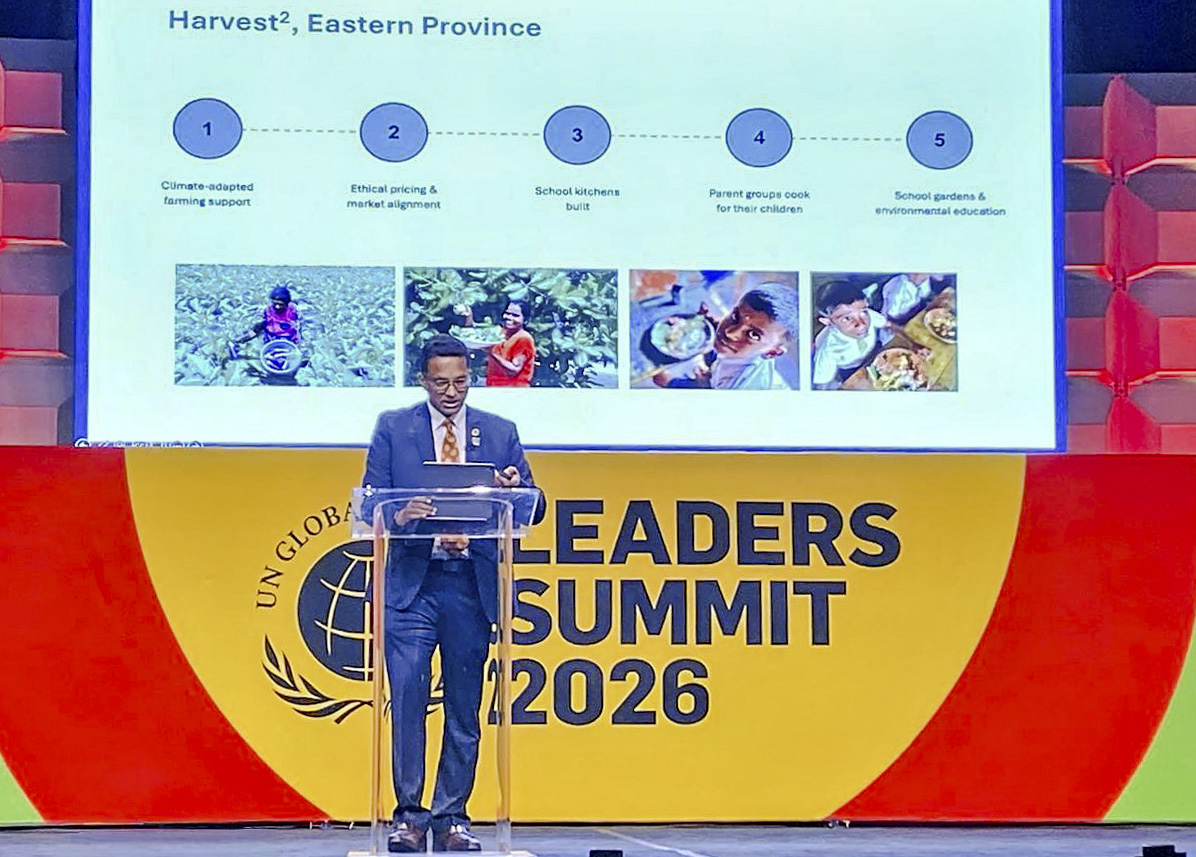
Capitalism was never meant to be a machine for extraction. That is the point I tried to make to the leaders gathered at the Global Compact Leaders Summit, and it bears repeating, because we have come to accept its distortion as though it were the original design.
When Adam Smith wrote about the wealth of nations, he meant wealth in its oldest and fullest sense: the wellbeing of a people, their capacity to live with security, dignity and hope. Aristotle, Ricardo and Mill asked the same question in different centuries. How does a society prosper? None of them asked how value could be drawn out of land and labour and gathered into a few hands as quickly as possible. That is not wealth. It is treasure, hoarded and personal, and it impoverishes the ground it is taken from. Somewhere along the way we confused the two, and then called the confusion growth.
I am a tea grower, and growers do not have the luxury of that confusion. We see its cost in the soil, in the rivers, in the rhythm of rains that no longer arrive when they should, and in the faces of families whose livelihoods depend on a price that has been negotiated down so often it no longer reflects anything real. Discount culture tells the consumer that food can become cheaper forever, with no loss anywhere else. But every discount is paid for by someone. Usually it is the farmer, the worker, and the land itself.
Our response to this broken market has been, very largely, to intervene around its edges. We regulate, subsidise, certify and audit, and we design ever more elaborate programmes to repair damage that the market continues to produce every single day. The evidence is before us. Soils are still degrading, biodiversity is still collapsing, rural poverty persists, and the young are leaving the land. Interventions applied to a system that remains fundamentally unchanged will always be outpaced by it.
Meanwhile, the solution stands in plain sight. Across the world there is a vast and productive reservoir of farmers and agricultural workers, hundreds of millions of people already living on the land where this crisis is unfolding, holding generations of knowledge about how that land behaves. They are not asking for charity. They ask for a fair price for what they produce. Pay it, pair it with knowledge and support in adapting to a changing climate, and a farmer ceases to be a cost in someone else’s supply chain. That farmer becomes a partner, and the largest workforce for regeneration the world could ever hope to recruit.
There is an equally important truth in this too. When soil is cared for, it gives back. Living soils, thriving biodiversity, clean water and clean air are not only ecological goods; they are expressed in the produce itself. Tea grown with care, on land that is respected, tastes better. Food grown in healthy soils is richer in the goodness we eat it for. The race to the bottom in price has been, all along, a race to the bottom in taste and nourishment. A fair price is not simply just. It is the path back to food worth eating.
This is not sentiment. It is economics as it was originally conceived, concerned with prosperity rather than profit alone, with people rather than line items. My father built our family business on the conviction that business is a matter of human service. I believe that conviction is not a relic of a gentler age but the design principle of a market that could actually work.
What follows is the full text of my address. I share it in the hope that it prompts reflection, and perhaps disagreement, but above all a question we should ask of every plan, every price and every business model: progress for whom, at whose cost, and measured by whose values?
This is what I explained at that august assembly:
In 1962, a marine biologist named Rachel Carson looked at the world we were building and warned:
“We stand now where two roads diverge. The road we have long been traveling is deceptively easy, a smooth superhighway on which we progress with great speed, but at its end lies disaster. The other fork — the one less traveled by — offers our last, our only chance to reach a destination that assures the preservation of the earth.”
She was writing about pesticides but also warning us of a falsehood – the belief that we could take, endlessly, from people and nature, and never have to pay the cost.
Forty-two years later, law professor Joel Bakan – Rhodes Scholar and graduate of Oxford and Harvard, looked at the institution built to do the taking. He described the modern corporation as being “singularly self-interested and unable to feel genuine concern for others in any context,” compelled by design to externalize every cost it can.
Carson warned us about the taking. Bakan warned us about the structure built to take without limit. In 2006, former Chief Economist of the World Bank, Nicholas Stern connected both: in his Review on the Economics of Climate Change he called it “the greatest market failure the world has ever seen,” evidencing – as an economist – that acting to avoid the worst impacts of climate change would cost roughly one percent of global output, while failing to act would cost nearly twenty percent.
Here is the irony behind that; our economy prices what is scarce and easy to extract, and calls what sustains all of us — clean air, fresh water, stable soil, medicine born of the natural biochemistry of a rainforest — a free input. Adam Smith knew it as the diamond – water paradox – diamonds, considered precious and priced accordingly yet utterly useless for staying alive, and water – essential for life yet priced at an insignificant level. Least value attached to what is most important.
I am a tea grower. I and every other farmer knows the truth Rachel Carson alluded to – nature keeps her accounts. What we call “externalities” she calls debt. That debt is now tragically overdrawn, manifest in a massive yet avoidable cost to humanity.
In 2025, more than 240,000 people were killed in armed conflict worldwide. In that same year, at least 16,600 people were killed directly by weather and climate disasters. Heat alone kills an estimated 546,000 people every single year, according to the Lancet Countdown on Health and Climate Change. Nearly 7,900 people died or vanished on migration routes last year, most of them fleeing drought, floods, and conflict.
Conflict. Climate. Displacement – one crisis wearing three faces — the confrontation between a world that has failed to price what is important – people and nature, and the compounded cost of that failure.
There is a fourth which rarely generates the same alarm because its impact is slow. More than 1.2 billion people now live with a diagnosed mental health condition — a ninety-five percent increase since 1990. Chronic loneliness alone now linked to 871,000 deaths a year.
In business we judge plans by their results, not intentions. Last month, floods in Nepal killed more than 1,300 people, in a disaster its own Prime Minister said there was “no doubt” climate change had driven. In the same weeks, the FAO’s Food Price Index hit its highest level since 2022, pushed up by the same climate shocks. Any plan producing these results — rising conflict, unstable climate, collapsing food system, and a population growing sicker, lonelier, and more anxious — would have been thrown out a decade ago if there was an honest assessment.
For most of us in this room, these are statistics — insurmountable, but unlikely to be endured directly. For my family and for farmers who grow the world’s food, they are our daily reality: drought, floods, conflict. And onto that reality something entirely of our own making yet so devastating to livelihoods, soils and biodiversity — discount culture and a middleman’s profit vastly disproportionate to anything we as producer could ever hope to derive.
We are on the frontlines of our collective battle for survival, and yet hamstrung in our response by a global fascination for cheap food. Logically, that pushes most growers toward compromise — soils, wages, the produce itself — a spiral of decline that begins with the loss of taste, nutrients and goodness, ending in disaster, for consumers and growers alike.
And this confrontation is not new. For centuries the powerful have called their extraction of other people and lands “progress.” The vocabulary changed — “civilized” became “developed,” “savage” became “underdeveloped” — but the hierarchy, and the extraction, persisted.
I grow tea on land cleared under exactly that justification. The question is this – progress for whom, at whose cost, measured by whose values?
Business as usual, in that environment, is slow-motion self-destruction. Every input a company depends on — stable climate, secure water, functioning supply chains, a workforce with enough security to turn up — is degrading. A business treating sustainability as a cost while the ground beneath it erodes, mistakes survival for expense.
That belongs to the private sector as urgently as to any government. Managing the existential crisis we are in is a specialised craft, not a popularity contest; winning an election is no guarantee of the suitability of a government to handle such complex and severe challenges. Hence the role of business in initiating collaboration with academia, NGOs and government.
So where do we begin? Everything we do from here must start with a single question: what are we actually trying to achieve? That is where economics itself began, long before Adam Smith. Over two thousand years earlier Aristotle laid the philosophical ground, distinguishing an item’s use value — what it is worth to whoever holds it — from its exchange value, what it fetches in trade. Smith himself, in 1776, gave us the invisible hand, free markets, and the division of labour — but he asked why nations prosper, not how to maximise a shareholder’s return this quarter.
Ricardo asked how wealth is distributed. Mill asked how prosperity could improve society. The modern caricature of economics as simply about money would have surprised every one of them: they were concerned with prosperity rather than treasure, human welfare rather than output alone, the public good rather than private enrichment.

None of them intended the system we now operate to behave the way it does. None designed a machine for externalising cost onto the voiceless and unborn generations — we built that ourselves, and mistook it for growth.
We made a mistake, but it is now costing humanity its margin for survival. Correcting it will come from the same instinct that animated Aristotle, Smith, and Mill — leadership guided by evidence, not to plead for better behaviour inside broken markets, but to design markets that enable action.
Last year, Nicholas Stern returned – 20 years on. In ‘The Growth Story of the 21st Century’, he writes that we can “forge a new path for economic development” that breaks the destructive relationship between production, consumption, and the environment, delivering “a much more attractive structure for growth and development, with rising living standards across all dimensions.” Not sacrifice but opportunity — the greatest of our century.
UCL Professor Mariana Mazzucato, in The Common Good Economy, explains why the opportunity sits unclaimed: economics has always treated “the good” as something to patch around the edges of the market, rather than something to build the economy around from the outset.
I know this can be done at the level of one company. I shared yesterday how my father, who could not afford a university education, built our family business on the conviction that kindness should define a business as much as an individual — “business as a matter of human service”. He challenged a century of economic colonialism in tea, and turning that conviction into a structural rule in 2003: a minimum of fifteen percent of our pre-tax profit, every year, to fulfill a promise of kindness via our MJF Charitable Foundation and Dilmah Conservation.
In Sri Lanka’s Eastern Province that structure funds Harvest², pairing smallholder farmers on fair-price contracts with mothers’ cooking cooperatives that supply daily meals in its first phase – to more than 2,700 children daily across twenty-three schools, with environmental education through school gardens teaching the next generation what the land they depend on actually needs.

I have to be honest about the limit of that story: one company proving a point does not change a market. A single business can absorb the cost of a fair wage, and still be undercut by a competitor that externalises the same cost. Richard and Martha Anker, whose Living Wage methodology is the global standard for measuring this, put it plainly in their report on Sri Lanka’s tea estates: “most Third World exporters have a limited ability to raise wages to a living wage… participation of the entire value chain is required.” This cannot stay a story about a few kind businesses – it has to become the standard, reshaped collectively.
That is what the accelerators in this room exist to do: turn one company’s proof of concept into a benchmark for a category. The Climate Ambition Accelerator evolves a wish to decarbonise into a shared, measurable outcome. Target Gender Equality moves women into leadership across whole sectors. This is systemic change built the only pragmatic way it ever has been — one business proving it possible, a coalition collaborating to make it normal.
The economists who built our current model made an error at the very foundation of the discipline: they treated nature — finite, fragile, keeping careful accounts — as though it were infinite and free. Land, water, air, biodiversity: inputs, not capital. That single error, compounding for two centuries, is the root of everything else in this speech. Correcting it is a design task, not a plea for conscience: a market that prices nature at zero will keep producing this outcome no matter who is running it. A market designed to enable the right action produces a different outcome by default.
You can see the alternative on any high street, any app, any Black Friday. Everyday Low Price built retail empires on the promise that price could fall forever with no fall anywhere else. Black Friday now spills across a week; Singles’ Day can move more merchandise through one platform in a day than many nations produce in a year. A hard discount, traced through its supply chain, is rarely a triumph of efficiency — it is a cost simply moved: onto the grower, onto the river that absorbs what the factory cannot treat, onto the worker whose wage is easiest to cut.
Someone always pays for the discount — because a price that excludes its true cost is not low. It is deferred, with interest, onto people and nature who never agreed to the loan.
What remains is the only thing that was ever going to be hard: collaboration built more for resilience than applause — a coalition that treats mitigation and adaptation as one project, designs markets that enable action instead of merely tolerating it, and invests in supply chains built to still exist in twenty years. There is no third road on which that cost disappears. There is only the choice of who pays it, and when.
The deepest failure in all of this is not economic. A misinterpretation of economic theory has dehumanised business — reduced people to line items in quarterly accounts, and line items into a reason not to look at the people. We must never forget our humanity.

Fair pricing is not charity to a grower; it is capital. Pair a price that aligns with value, together with access to knowledge, quality systems, and support in climate adaptation and regulatory compliance, and a farmer stops being a cost in someone else’s supply chain. Instead that farmer becomes a partner capable of the work that regulations alone cannot achieve — restoring soil, protecting biodiversity, securing a rural livelihood, educating the generation that will inherit the land. That is how the world closes the twelve trillion dollars its agrifood systems lose every year to hidden health, environmental, and economic damage: not through a subsidy line in a government budget, but through millions of growers equipped and enabled to be the agents for change they have always had the knowledge and commitment to be. Enable the producer, and you do not just fix a supply chain. You recruit the largest workforce already standing on the ground where this crisis is happening.
Please look at these faces — people I met two weeks ago amongst the 2,500 beneficiaries of our small entrepreneur programme – rebuilding livelihoods with their own hands. With commitment, capability, and in many cases, passion. And they know their lives depend on it. People.
Wherever conflict grows, the climate warms, and extreme weather outpaces people’s patience in a spiral of decline. Profit will move, as it always does but it is people — those already born, and the many not yet born — who matter more than any figure on a balance sheet. That is the humanity economics was built to serve, and the one we must never again mistake for an externality.
Let’s end the indifference to the people who make our food to respectful collaboration and build instead a relationship of respectful collaboration, for humane progress. with humanity.
Thank you.
