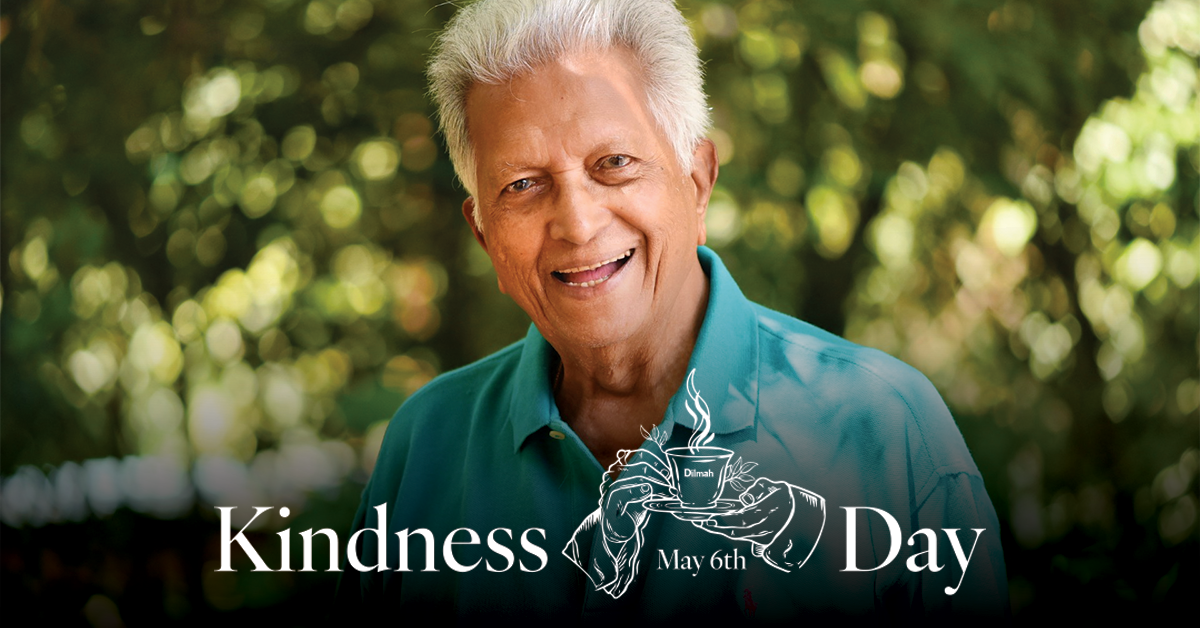
It was the anniversary of my father’s birthday earlier this month. Merrill J. Fernando was born on 6th May, 1930, in a village called Pallansena. He passed away in 2023. The date did not lose its meaning when he passed though. For the global community we call our ‘Dilmah Family’, it gained significance. We call it Kindness Day; in celebration of the birth of a remarkable philosophy that defined his life, now shapes ours and impacts hundreds of thousands each year. This year, we make fresh commitment to the powerful truth that was Merrill J. Fernando’s philosophy, that business must always serve humanity.
Kindness Day unfolded across Sri Lanka in a way that would have made my father smile. At Dilmah Head Office, dry ration packs were distributed to over 1,000 families. At Apeksha Hospital in Maharagama, our teams delivered nutritional supplement packs to children. On Wednesday afternoon, at the Mother Theresa Elders Home in Mattakkuliya, eighty-five elders shared evening snacks and dinner with our people, with songs and conversation filling the hours between. That evening, at the Suwa Arana Centre in Maharagama, children and their parents sat down together for dinner, hosted by our Dilmah Family.
In the MJF Foundation Centres, the day was alive with purpose. My family’s celebration started at our Centre for Children with Cerebral Palsy and Developmental Disorders in Rajagiriya, with a compelling presentation of the ability of people society considers disabled; the children and their parents marked the day joyfully. In Batticaloa, our team at MJF Centre East team served breakfast to the wonderful people and staff at the Little Sisters Elders Home. At Senthnery Tamil Vidyalayam in Vellaveli, a nutrition programme started, offering lunch to every student as part of a programme that will soon span 23 schools and over 2,500 students.
In our MJF Centre Moratuwa, students, their parents and staff engaged in mindfulness to ease mental stress, facilitated by the Peace Centre. At the Centre for the Handicapped in Kundasale, we met with individuals who will soon receive prosthetic limbs from the MJF Foundation. Across our East, West, Jaffna and CCCPDD centres, food packs were distributed, each sufficient for a family to eat balanced meals for 2 weeks.
On our Kahawatte Plantations workers and staff gathered at first light for a moment of reflection and prayer. This is how my father always celebrated special occasions – with generosity toward others. Kindness Day is the celebration of a birth, and the legacy that followed by the Grace of God. It was the perfect occasion to also share something deeply meaningful to us as a family.
On Kindness Day 2026, we announced a refreshed Vision and Mission for Dilmah — one that honours the past while setting the compass for the future. Before I share that, some context.
Kindness as defiance
My father could not afford an university education. People I mentioned that to often remarked that it saddened them, although I believe it was the opposite; what guided my father was not conventional business and its focus on profit, but his faith in God and the values his mother instilled in him. Principally the realization that the reason you make money is to give it away to people less fortunate than you are.
That is not charity or sentimentality; it is the foundation of a philosophy that defines our family business. My father’s devotion to tea, and his pursuit of kindness began in 1950, with a loan of Rs. 10,000 (less than US$50 at the time) and what most felt was an impossible dream — he wanted to create a genuinely ethical, producer-owned tea brand from a country still reeling from centuries of colonial exploitation. Four and a half centuries of colonisation had ravaged Sri Lanka’s wealth, and its self-determination.
Sri Lanka – then called Ceylon – gained political independence in 1948, yet it was anything but independent economically as its key exports and revenue streams were in the hands of the heirs to colonial power, transnational corporations that controlled the commodity chain, buying Ceylon Tea as raw material, blending and ‘adding value’ to extract profits far from the people who grew it.
My father spent thirty-five years battling that system before Dilmah reached its first customers in 1985. In those years he was neither slow nor patient; he was relentless in his defiance of a system of economic colonisation that his peers accepted as inevitable, which sadly persists to an extent even today. Fortunately he prevailed – armed solely with invincible faith, integrity, kindness and determination to achieve what he knew was right.
Dilmah was the first tea grower to market his own produce directly to consumers. As simple as it sounds — that was a revolution at the time. It returned value to the land and the people who worked it and ensured that quality was not sacrificed for margin. It also created the economic foundation for something my father believed in: sharing the benefits of success with those who need it most.
for People
This is where the MJF Charitable Foundation comes in, formalising my father’s belief in kindness as a principle of business and forming the heart of ours. My father committed a minimum 15% of our pretax profits to the humanitarian work of the Foundation — not only when times are good, but always. Alongside his principle of integrity in quality, that commitment is honoured without compromise. It is not a marketing effort in the guise of CSR, and since 2001, that philosophy has delivered over Rs. 9.6 billion (US$ 56 million at the prevailing rate each year), in social and environmental initiatives through the Foundation and through Dilmah Conservation.
The Foundation works across five interconnected themes: serving children with disability, where the focus is on ability through education, creativity and therapy; on education, delivering formal schooling, life skills and vocational training for less fortunate youth; supporting the welfare of tea and cinnamon communities, addressing nutrition and welfare across plantation populations; on dignified empowerment, fostering sustainable entrepreneurship that restores dignity alongside income; and healthcare, strengthening capacity in emergency care and the management of severe illness.
The reach is extraordinary. Nearly 673,000 beneficiaries across Sri Lanka — from Point Pedro in the far north to Weligama in the deep south, from Kalkudah on the eastern coast to Moratuwa in the western heartland. Twelve community centres spanning the breadth of the island. Programmes that include the Rainbow Centres for children and youth, MJF Kids programmes nurturing potential, the Curtiss Institute of Design Technology training young people in marketable skills, Women’s Development Programmes, Small Entrepreneur Programmes that support women and people with disabilities, People’s Markets that give communities economic agency, and the Good Heart Café in Moratuwa that turns social enterprise into daily practice.
In healthcare, the Foundation’s investment has been transformative — the construction of hospitals, the provision of essential medical equipment, the deployment of seven ambulances for emergency patient transport, and a cervical cancer screening programme for women over thirty-five. At Nawalapitiya District General Hospital alone, the impact extends to over 500,000 beneficiaries. On the plantations where our tea is grown — Kahawatte, Elpitiya, Talawakelle, Dunkeld — we provide nutrition programmes for children in community development centres and scholarships that open doors that would otherwise remain shut.
In Rajagiriya, the Centre for Children with Cerebral Palsy and other Developmental Disorders is a place of extraordinary compassion and determination, where children whom society too often overlooks are given the care, therapy and love they deserve. In Peliyagoda and Pahalalanda and Siyambalanduwa, young people are learning trades, building businesses, discovering their own capacity. In Colombo, the Early Intervention Clinic is reaching children at the most critical window of their development.
These are not just numbers; they are lives changed and the living expression of my father’s conviction that kindness is not charity but a part of being human.
for Nature
If the MJF Charitable Foundation is the heart of Dilmah, Dilmah Conservation is its conscience. Established in 2007, it works alongside the Foundation across four core pillars: biodiversity conservation and restoration, environmental education and awareness, climate resilience research and sustainability, and environmental advocacy.
The Endane Biodiversity Corridor is perhaps the most vivid expression of what Dilmah Conservation stands for. In the wet lowlands of Sri Lanka, two fragmented forest patches — Iharakanda and Walankanda — had been severed from one another, leaving wildlife isolated and ecosystems degraded. We are creating a forested corridor through our tea gardens there to reconnect them, converting forty hectares of degraded tea land into tropical lowland rainforest, establishing long-term monitoring plots, and planting over a hundred globally threatened species.
A new Memecylon species was discovered here — a plant that might otherwise have been lost forever, now protected in our threatened plant nursery and arboretum. The project received the BCCS Award in 2023 and has been supported by the Franklinia Foundation. It is a powerful demonstration that restoring land can help protect life, and that a tea company can be an instrument of ecological renewal.
At our Queensberry Estate in Nawalapitiya, the One Earth Climate Change Research Centre has supported over twenty climate studies and fourteen scientific publications since its founding in 2017. The tea industry is experiencing the impact of climate change — altered rainfall, shifting temperatures, evolving pest dynamics — and our research responds directly to those challenges.
Current projects include the conservation of Kudalu, a rare endemic plant; a bat conservation initiative that promotes bats as natural pest controllers in tea; and a leopard conservation project focused on coexistence, conflict mitigation, and habitat protection. In collaboration with the South Asian Nitrogen Hub, a globally significant study on nitrogen pollution was conducted here — science rooted in tea country, addressing challenges that extend far beyond it.
The One Earth Centre in Moratuwa, with its Urban Arboretum, Butterfly Garden and model Organic Garden, brings environmental education into the heart of urban life. In Kalkudah, our eastern centre supports environmental education, research for undergraduates and field visits for school students. The Greening Batticaloa initiative planted approximately one million cashew trees in the east, restoring degraded land and strengthening community resilience in post-conflict areas. It was a peacebuilding exercise, connecting the social and economic welfare of the people with our environmental objective.
Dilmah Conservation’s marine work is equally significant. It was our documentation of the Kayankerni Reef that contributed to its declaration as a protected marine sanctuary. In 2024, we formalised the “Life to Our Coral Reefs” project — a nature-based solution delivering environmental and socio-economic benefits. Beneath the Waves, our collaboration with Uva Wellassa University and the University of Colombo, studies new coral growth, while an upcoming Blue Carbon Project examines how Sri Lanka’s mangroves, seagrasses and salt marshes store carbon and support climate resilience.
At Beddagana Wetland Park, part of the Colombo Wetland Complex, we are partnering with the Urban Development Authority to revitalise this urban ecosystem as a wetland education hub. At Udawalawe, our Elephant Knowledge Walk raises awareness of elephant behaviour and human-elephant coexistence — we have adopted four elephants and will extend support to seven within the year. Our beekeeping programmes support both pollination and sustainable livelihoods. Our amphibian conservation efforts focus on sensitive indicator species. And at the Dilmah Genesis Centre in Colombo, we drive change through dialogue, research and partnerships, translating science into action for a sustainable future.
Dilmah Conservation has published more than sixteen works to date, including Shyamala and the Sloth Bear by Professor Jody Miller — our first children’s conservation publication — Discovery: Flora of Ceylon, by Dr. Himesh Jayasinghe, a valuable contribution to the country’s botanical knowledge. Through Grey2Green, we are transforming degraded spaces into functional ecosystems. Through the Stronger Together initiative launched in 2023, we are working with partners across the tea industry to co-create better standards for biodiversity, agro-forestry, worker health and welfare — not top-down, but collaboratively.
Kindness abroad
My father’s philosophy of kindness was never confined to Sri Lanka. He believed that the act of sharing tea carried with it an obligation to the communities in which Dilmah is present — everywhere. This is why our partnerships abroad are not marketing exercises but genuine expressions of the values on which Dilmah was built.
In New Zealand, our partnership with Hospice New Zealand has endured since 1997 — nearly three decades of donating all the tea each hospice service could need, every year. Over eleven million tea bags have sparked conversation and comforted people in palliative care and their visitors. When Hospice New Zealand awarded Dilmah a gold medal in recognition of our contribution to the hospice movement in Aotearoa, it affirmed something deeply personal — that a cup of tea, offered with care, can comfort people in the most difficult moments of their lives. For those in the care of hospice and their families, the simple act of sharing tea provides the small pleasures and comforts of home. It is precisely the kind of kindness my father cherished.
In Australia, it is our privilege to support MyRoom Children’s Cancer Charity — a volunteer-led organisation dedicated to achieving a hundred percent cure for childhood cancers. We also support The Salvation Army across Australia, donating tea to community centres and supporting people experiencing homelessness, hardship and crisis. A cup of tea, is more than a drink — it is an invitation to connect. Alongside this, through our new five-year partnership with Cancer Council Australia and the Biggest Morning Tea initiative, we extend that invitation further — bringing people together around a cuppa in the service of something that matters.
To those partnerships I add more recent ones of a different kind. Bundaberg Brewed Drinks, an Australian family business that genuinely echoes our belief in kindness, supported the work of the MJF Foundation in strengthening survivors of Cyclone Ditwah on tea gardens, That programme ensured educational continuity, adding emergency support with food rations, post natal care for newborn babies and continuing beyond those early interventions. Another more recent partnership is the shared commitment to nutrition that we have forged with Shaun Christie-David, his mother Shiranee and their Plate-it-Forward. That will be the subject of another story. These partnerships are birthed in kindness, and they are not peripheral to our business, but central to it.
It is not possible to capture the scope and breadth of the impact of Dilmah in a single post. Impact, an e-publication that is updated twice a year, offers a more comprehensive overview
A Vision and Mission Refreshed
The Vision and Mission for Dilmah is fresh affirmation of my father’s legacy.
This is our Vision; every cup of Dilmah is an act of kindness — and defiance. My father built our company on a refusal to accept commoditisation, compromise, or indifference to the people who grow the world’s food. That is our inheritance and our promise. We grow our Teas and Ceylon Cinnamon with respect for the land and the people who tend it, and we share what nature gives us with both. We are a family business in the most traditional sense. Quality, Integrity and Purpose are not aspirations — they are conditions for our existence.
This is our Mission; to craft the finest tea and cinnamon in the world — growing responsibly, innovating boldly, and sharing generously. We will bring great Taste and natural Goodness to the people who drink our tea — and Kindness to the land and people who make it possible.
My father’s passing gave us the responsibility to express the values he embodied with greater clarity and effect. As growers, our responsibility begins with soils, continuing through biodiversity, the livelihoods of our people and their families, the health and happiness of our community, and those who consume what we grow. We believe every business has an irrevocable obligation to People and Nature, and a symbiotic relationship with the communities and ecosystems in which it operates.
The promise at the end of our mission statement captures everything my father stood for: to make the world a better tea. If you can make tea with integrity, purpose and kindness — if you can prove that a business built on those values can thrive, and form its strength and resilience around those values while touching the lives of hundreds of thousands — then we have a powerful guide to the kind of world that is possible with kindness.
Kindness is part of being human. For us it is also our greatest strength in unkind times. It is not just in scholarships that keep children in school, therapy that helps a child with cerebral palsy know joy, the corridor of rainforest that allows species to move freely, enriching habitats, the cup of tea offered in a New Zealand hospice, the rations delivered to a family in need, the entrepreneur given the dignity of self-reliance. It is their combined impact of People and Nature, demonstrated in the power of our global family to take a stand against greed, compromise and extractive business.
It began with one very ordinary man with a desire to make the world better. He was armed only with faith and determination, yet – for growers especially – he changed the world as we knew it. Happy Kindness Day, Thathie.
