Why a Forest is Greater than its Trees
With Prof. Devaka Weerakoon
About this episode
Dilhan chats with Devaka Weerakoon Ph.D, Senior Professor of Zoology at Colombo University on why a forest is greater than its trees. The conversation is supported by images and examples from the eminent Professor Weerakoon’s experience in Sri Lanka on the value of forests for human welfare and survival and concludes with an exploration of what life would be without forests.
Transcript
This transcript was created automatically from the audio and checked for names. Minor errors may remain.
Over a Cuppa with Dilhan Fernando. Good morning, everyone. My guest on Over a Cuppa today is Professor Devaka Weerakoon, Professor of Zoology at the University of Colombo. More than that, he's a passionate and learned scientist who loves the environment and has a very practical perspective on forests. Devaka, good morning and welcome to Over a Cuppa. Good morning, Dilhan. It's my pleasure to be with you this morning. Devaka, I have a question for you. The world is talking about forests and how important they are. And so most people see trees, but I would like to ask you, is a forest more than just the trees that it comprises?
Okay, give me a second to share my screen with you, Dilhan. I would like to show some photographs. So basically, what you see in this map is the forest cover of the world, forest cover roughly about 30% of the Earth's land surface. And it also supports a large number of living organisms, nearly more than 75% of living organisms on land, forest dwellers of one way or the other. But to get back to your question, what is a forest? Is it just a bunch of trees or is there more to it? So basically, what I'm showing you here are three potentially different vegetation types. What you see first is a grassland, which is a very short vegetation type, which may vary from a few inches to several feet.
And then in the middle here, you can see a plantation, which is mostly a monocrop, could be a rubber plantation or a teak plantation or eucalyptus, where you can see the structure is very uniform. You have the tree canopy, the tree trunks, and then few shrubs on the ground here. And on the very corner here, you can see the forest. And the first thing you would notice is that it is very complex. It has multiple layers. And if I may take a more detailed photograph, what you see here is a cross section of a rain forest, where you can see that there are a number of layers, like these trees that are coming, jutting out of the forest canopy, which are called emergence.
Then the trees that make up the canopy of the forest, then you have a sub canopy, understory, and so on and so forth. So what this creates is a very complex three-dimensional space. And therefore, it provides a number of different lifestyles. There are things that live in the canopy, things that live above the canopy, things that live in the sub canopy. There are things that are living in the tree trunks, in tree holes. There's a whole bunch of species that live in tree holes. And so what this creates is a very complex three-dimensional space, which provides various types of lifestyles, what we refer to in technically as niches. So that means even if you take a unique area of forest, it can support a much broader assemblage of species compared to a plantation, or a grassland, or any agricultural field.
So that is one answer to your question. Is it just a bunch of trees, or does it transcend beyond a collection of trees? So one answer is, yes, it's a very complex three-dimensional structure that provides very different lifestyles. And also I think what we have to know, I'm showing you here some major forest types in Sri Lanka, which is again governed by climate. So Sri Lanka has three climatic zones, wet, intermediate, and the dry. So if you go and look at a forest somewhere here in the lowland wet zone, it's a very complex rainforest, very tall trees. And it has the complex structure I just explained regarding the forest structure.
This is because there is a lot of water. This type of forest requires very heavy rainfall. But when you go up here to the mountains, you see the forest structure changes. The trees become null. They become shorter because there is more wind on the top of the forest. And then if you just cross over to the dry zone, you will see the trees are now more spaced out. There is more space between trees, which allows bigger animals to roam, like elephants, leopards, spotted deer. But when you go to a rainforest, you get very few big animals, large animals. And then when you go to the coastal zone, you have things like mangrove forests, which grow in water-logged soil.
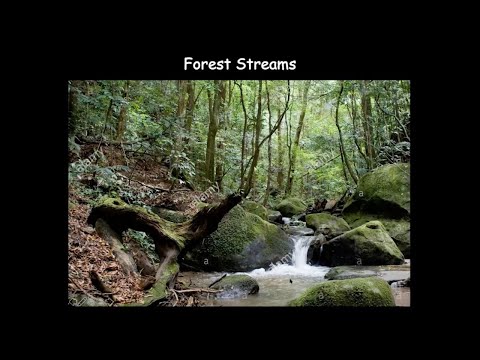
And therefore, they have a unique set of attributes to surviving such an environment. So the second answer to your question is not just a bunch of trees. It's defined by the climate, the physical conditions. The forest will vary, and also the types of species that you have will also change with these conditions. And thirdly, if you look at the forest, one of the main functions it does is it traps water. It intercepts fog, like if you go to a newer area, this kind of scenery is very common. But even further down, you can see the trees can trap water, rainwater, fog. And then the water slowly trickles down to the ground.
And therefore, the speed at which water hits the ground decreases. And therefore, it reduces soil erosion. And then the forest flow absorbs the water and releases it slowly, so there is year-round flow in the streams. So then when you go into a forest, you not only see trees, you see these kind of streams, which have very clear water. And it supports, again, different kinds of animals who live primarily in water, as well as animals who transiently associate with it. And the other thing I would like to point out is when you look at, now, this is a photograph of a rainforest from Malaysia. You can see how rich this habitat is, so many trees within such a small area.
So one would assume that this, to maintain such a big biomass, you need lots of nutrients. Now, we know in our agricultural fields, we use lots of nutrients to support the trees. But if you go to a forest like this and look at the soil, you find that the soil contains a very thin nutrient layer, very little organic matter. Because forests are very good at recycling the limited resources they have. So whenever a leaf falls on the ground, a twig falls on the ground, or a tree falls on the ground, they are quickly recycled and reutilized. So the resources are empty, recycled. Therefore, there is no dirt of nutrients.
However, if you remove things from here, that affects the recycling. This is why we ask people not to remove forest wood from the flow of asphalt wood and so on. Because if you take something out of the forest, you take it away from this very efficient recycling system, creating a little imbalance. So that is why we would like forests to be left alone so they can support itself without any additional support from us. And when we talk about the soil, there is another thing that I would like to mention here. Whenever a person walks to a forest, what they see is what is above ground. We don't see what is at the ground layer or what is below ground.
And below the soil, that is the soil biodiversity or the below ground biodiversity, is also very important in a forest. And most of these are very small microscopic organisms, but they carry out very important work. They are the ones who recycle everything, and they are the ones who support this incredibly rich assemblage of trees. So to give a long answer to your question, is it just a bunch of trees? No, it's a very complex system. It has a very complex structure. It provides a lot of lifestyles. And it survives on its own because it is very, very efficient in recycling the limited resources it has. And it has created a massive biomass. So I would look at forests as a very complex organism.
That's incredible in terms of the sophistication. But I suppose that we all know that nature has a perfect work in so much of what we see. So when you look at this complex forest ecosystem, what is its relevance and function where humans are concerned, where our lives, livelihoods, food and economic systems are concerned? Yes, that's a very interesting question because I think forests are incredibly important for people. There are certain people, like if you go to some of the South American forests, they live their entire life in the forest. Their whole life, the livelihoods, everything depends on it. So when we talk about these forests, we use the term ecosystem services.
That is to explain the different types of goods and services we derive from natural systems. For us, it's a natural system. So one of the things that we derive from forests is food or goods that we can directly use, like food, various types of spices, medicine, timber, all these are things that we directly use, touching material for roofs. If you look at some of the, we don't do that anymore because we have now replacements like asbestos and so on. But in the past, if you go look around many of the houses near forests, they are all built out of material collected from the forest. So it provides you shelter, it provides you food, it provides you medicine, it provides you a lot of things which are called provisioning services. But I think one of the most important things that forests do is they provide us fresh water, clean water and clean air because forests are able to trap particles in the air, it's able to remove some of the carbon dioxide and it's also able to
cool down the entire area. When you go into a forest, you immediately feel a coolness that you don't feel outside. So these are other things that it provides us. But there are a number of things that the forest provides us that we do not really take into account because some of the services that the forest do, they do it very silently. We only understand it when the service is not there. So these are some of the services that I would like to point out some critical services like supporting pollinators because our whole food security depends on food that we produce. So when you take agriculture, one of the most important things that control the yields of agricultural produce is pollination. So most of the pollinators live in the forest like wasps, bees, a number of other small insects, birds. So they are forest dwellers who come out of forests, pollinate our agricultural fields and helps us to maintain yields. So that not only support our food security, it also support the farmers, their livelihoods and so on.
Then the forest dwellers also help us to disperse seeds, recycle things. And also since the forest is able to absorb rainwater and slowly release it, it prevents droughts as well as floods. These are two of the most critical things that we face because I think especially city dwellers like us, floods are a big issue. But if you're a farmer, both droughts and floods are not good for agricultural practice. So these kinds of supporting services are also very important. And then the forest regulates lots of things. It regulates the cycling of water. Without water, life itself is not possible on this planet. But forests are the ones that help us to keep water cycling. It also traps material in the water. It removes toxic material, so it purifies water. And this is another very important function because it removes carbon dioxide from the atmosphere. Today I think one of the most critical problems we are facing is these climate change related issues which are driven by greenhouse gases, fundamentally CO2.
So forests are able to remove CO2 and sequester them in their biomass and therefore it helps us to, it is our first line of defense against climate change. And finally, the forest also gives us these kinds of services, spiritual renewal, opportunity for recreation, which can of course convert it to industry, the whole eco-tourism industry. And then also a lot of people have certain spiritual connectivity like in Sri Lanka. You have all three religions going to peak wilderness. Peak wilderness or Samana La Adevir is not only for Buddhists, the Christians go there, the Muslims go there. So it allows religious harmony among people. And also forests are incredibly rich laboratories where we use these laboratories to train people and we go there and try to understand this complex system which itself is very invigorating. So to answer your question, what is the value of forests to us? The forests, the values are immeasurable. And I know some people have tried to, there's a whole discipline called environment economics where we try to put values to forests. But when you look at the complex
services they provide, I do not know whether even we can begin to start to fathom the total value of a forest. So they're the incredibly valuable resources for human beings and all the other living organisms that we share this planet with. So Devaka, what you have very compellingly presented is that forests are not only life-sustaining but actually critical for our survival from pollination and food security aspect, from cultural aspect in terms of our our senses and our well-being, but also in terms of the ecosystem services or the critical life support systems that it presents. So if we were to venture, to do what you mentioned talking about the economic aspect, if we were to venture a guess, would there be some sort of benchmark on how within our conventional economic system we might value a forest?
Actually, I would like to share with you this experiment, incredibly massive experiment that humans did a few years back. It's called Biosphere 2 where they try to create ecology. So they created a closed space, they put, they created various types of ecosystem and it's a closed system. They try to keep it a self-sustaining system and they put eight people into this and these eight people lived in this system for two years completely depending on what is provided by the system. So this was actually a prelude I think to see whether we can go and colonize inhospitable places like planets, like planet Mars and so on. But the first cycle was successful, then the first eight biospheres came out, the second set went in, within few months the whole system began to collapse. So having spent millions of dollars to try to create ecology, what we found out that what we created was only good for a few years.
But if you try to extend this into the services that are provided by natural systems, I think the estimates are tremendous. They're like running to several trillion dollars annually because these services that we receive free of charge, if you try to quantify them, what is the service or what can you, now if you take city of Colombo, the wetlands, they help us to prevent floods. Now if you take the 2016 flood, the damage was estimated to be around 1.6 billion dollars. So if you lose the wetlands, that is the service you are losing. So using that kind of argument, the Colombo wetlands are valued at 16 billion rupees annually.
But do we really feel that, I mean if you convert these wetlands into land, maybe you can get few million rupees per perch, but that would be the end of that service. This is an argument that we try to forward and try to convince people that these things are very important, therefore we have to handle them carefully. Natural systems should not be converted unless it is absolutely essential for human development. But I find that a lot of these natural ecosystems are converted in a very unsustainable manner for human settlements or agriculture, which is one of the major challenges we face today in the world to convince planners that we have to pay more attention when we come up with development projects because these ecosystems are very important. Services we receive are very valuable and therefore we have to be very careful when we handle these natural ecosystems, especially for us. I guess it's about value, as you said, and possibly the issue is well, not possibly, but I think definitely the issue has to be, I mean for
me as a business person, the issue has to be that our very conventional and increasingly outdated economic system fails to recognize these so-called free goods, but it's a little like trying to see with your eyes shut to try to appreciate these things and I really hope this concept of value, and I saw some beautiful work done on the Great Barrier Reef and we can only hope that our community, our policymakers have the good sense to see and appreciate what we might be risking and on the subject of risking so many forests around the world from that incredible Amazon forest in Sri Lanka are under threat. Why do you think this is?
I think this is basically what we're talking about. We're converting much of the natural forests, natural ecosystems into agricultural land. There are 7.2 billion people in the planet and the estimates are that we'll be reaching 9 billion soon, which means 9 billion mouths to feed, so we have to produce food, but on the other hand, what I would like to point out is what we have in this world is not a lack of foods. There is unequal distribution of food and also we have a lot of post-harvest losses in Sri Lanka itself. We lose about 50 percent of what we harvest between farm to mouth, which means you have to produce double the amount of food in order to meet the required demand, and when you double your food production, that means you have to convert double the amount of land from natural systems to agricultural land.
So these are some of the issues I think we have to look at. What you see here is a map of the world where you can see the brown areas are areas that we have converted into agricultural land, so roughly about 25 percent of the earth's surface is converted to agricultural land, but what concerns me is this issue, because you can see two maps here. The one on the top shows the areas that we have converted into agriculture. One below is a map showing the biodiversity hotspots of the world. There are 36 biodiversity hotspots. Sri Lanka is also one, and these red areas that are marked in this map support 60 percent of this world's living organisms, and you can see that this conversion is also taking place in these very, very rich biodiverse areas, which has caused a lot of these species to become threatened. So this is the issue that we are facing. What you see here is the current trends in forests. All these red areas show that
the forest cover is going down. We can see only a few areas like Europe and some parts of China and Russia, where there is some improvement in forest cover. But rest of the world, especially this tropical belt, what you see here is the Amazon, the incredibly rich Amazon, the Congo, the Malaysian rainforest. In Indonesia, we are losing forest cover very rapidly. So more than the current estimates are like 13 million hectares of natural forest are lost each year. That's like about one-fifth the size of Sri Lanka annually. In Sri Lanka, we lose about 7,000 hectares. That's about one-third of Sinharaja annually. All of this for development. And when you lose forests, it's not only forests that we lose. We lose a large number of living species, because some species can live only in the forest. And I showed at the beginning that forests support a large number of animals and plants. So when we lose forests, we also lose species. And what is most disturbing is that forest destruction contributes about 20%
of the greenhouse gases. So this exacerbates an already challenging problem we are facing, which is climate change driven by greenhouse gases. So what we are doing is we take forests which stores carbon, which removes carbon from the air, and we release the carbon back into the atmosphere. We are doubling the problem of climate change by doing this. So I would like to share with you this. This is a satellite image taken in 2019. And all these red areas indicate forest fires in the great Amazonian basin. And the amount of forest lost is massive in 2019 alone. And this was not only restricted to 2019. The subsequent year, 2020, we had similar forest fires. Years before, we had similar forest fires. I just chose this just to show the magnitude of the problem that we are dealing with. And this is only in South America, where the similar situation in Australia, the same year, Australian wildfires resulted in massive loss of natural forest cover. So if you look at the Amazonian, these forest fires are driven by
slash and burn farmers. They're burning the forest, cutting and burning the forest for agriculture. So if you look at Sri Lanka, I'm just showing you these two maps side by side. This map shows the coverage of manmade tanks. And you can see the entire dry zone contains a large number of manmade tanks. These tanks were produced for agriculture to support agriculture. And what you see here is the forest cover in the dry zone. And when you compare these two, you can see that most of these areas, the forest would have been removed for agriculture during the hydraulic civilization that lasted from about 500 BC to 1200 AD. And then the civilization shifted to the wet zone, allowing these forests to recover. So if you look at most of the dry zone forests, these have been remodeled during the last 2500 years. We see the results of it. If you go to this forest, you don't see very few endemic species because when you remove a forest, the
endemic species or species that have evolved in this forest are the ones that are most sensitive to this deforestation. So you lose them. And you can see here the hydraulic civilization fell, the forest recovered, but what we lost can never come back. Extinction is forever. So that is why we see that in the dry zone forest, endemic species that are restricted to dry zone are very few. You only find them in this kind of inselbergs or mountains that are jutting out of the dry zone. So I think what I'm showing you here is the Geelong Mountains or the Margala Mountains in the Monaragala district. There are lots of these kind of isolated mountains that you see across dry zone, like Ritigala, Kokagala, and so on. And when we go to these mountains, we see there are lots of endemic species here, which sort of gives us an indication as to what we may have had and what we may have lost due to deforestation in the dry zone. Now the deforestation continues. This is what
these three frames show you what has happened to our forest since independence. So this is 1956, just after independence, we started reclaiming the dry zone with large irrigation projects. First things like Galway project, then in Udawalawe, and so on. Then subsequently, the Mahabali development program, which has resulted in large-scale conversion of forest into agricultural land and human settlements. Now what have we lost with all this? I think we have lost many things. We lose pollinators, as I've indicated earlier. Foresters are very important for pollinators. We see a global decline in pollinators, which is very concerned. People are very concerned about it, because without pollinators, our agricultural productivity goes down, which means we have to produce more and more, which means we'll have to convert more and more forests. So we get trapped in this very vicious cycle. You destroy more forests to grow, but your yields come down. So it's a never-ending thing, which will push us deeper and deeper into a crisis. Then we lose seed dispersal agents. We lose natural predators, because the species
that live in forests come out and feed on lots of insects that are potentially pests on our agricultural lands. There are things like birds, bats, spiders, small and medium-sized carnivores, now today we have a huge problem with peacocks, and their population is growing without control. One of the reasons we believe is loss of small pollinators like jackals. Like when I was very young, I grew up very close to Colombo in Belangwila. We had jackals in Belangwila, not anymore. They have just disappeared, because we have changed. The urbanization has removed them. So when you remove predators like jackals, it results in some of the species that are kept under control by these predators starts expanding, and some of them have reached pest situations in the country. We lose soil biodiversity, and we also, these forests function as barriers preventing large-scale movement of pathogens and pests in a larger landscape. So when you remove the forest, these barrier effects are gone. But I think one of the things that really concerns us today is the
human-wildlife conflict. Not a day goes by without us hearing something about human-elephant conflict, but we're not only in conflict with elephants, we're in conflict with wild boars, we are in conflict with peacocks, crocodiles, the list keeps growing. And if you compare the number of conflicts that are growing with what is happening to forests, you see on one side, we have reduction of forests, and on the other side, we have escalation of conflicts. So these things go hand in hand. And conflict obviously has a huge impact on agriculture, because most of the farmers are heavily influenced by conflict, or we cannot get the benefits of agriculture due to conflict. And we spend millions of rupees for agricultural development, but we don't get the desired results because of the conflict that occurs. And forests are extremely important for water cycling, and water is extremely important for agriculture. So once again, by converting forests to agriculture, we have compromised the water security, and therefore, ability to do agriculture. So this is basically what we are losing. This is the impact of
removal of forests without a sustainable plan, at least in my mind. Argument, Devakar, for any person, whether you're a businessman, individual, or a policymaker, but I think the importance of what we should focus on now is to ensure that there is awareness, and hopefully with awareness, there will be commitment, and in that way, we can try to induce change. But tell me, to add to this very compelling argument that you have shared, what would life be without forests, theoretically, hopefully? Okay, I can only imply what it would be based on what we know of evolution and history. Now, what you see here is planet Earth, which is unique because as far as we know, this is the only planet that can support life or that supports life at present. Now, this is a very old planet.
It's four and a half billion years old, and for nearly three and a half billion years, it was a planet that has oceans, but the land would have looked something like this. It was a blue planet. The land was not colonized by trees, so it's very desolate, very brown, the soil is exposed. So only about a billion years ago, plants started slowly colonizing the land, and then they start producing forests, and then they converted the land into a green cover. So what we see today is if you go back one billion years, this is what the world would have looked like. But today, we have a planet where about 30 percent of the land is covered with forest, and there's a lot of other vegetation types on the planet, which is now a blue-green planet. Now, what would life be without forests? This is what life would be to me without forests.
It's desolate, it's dry, it will not be able to support agriculture, so we will have issues with food, we will have huge problems with water, and I think even I've seen a number of books written, publications written about the future wars will be fought not for anything else, but for water, over water rights. We already see some of these conflicts arising in the world, so it is going to be a very undesirable world, where we will have many challenges with meeting the food requirements, the water requirements, and at the same time, because when the resources get limited and the population increases, the inevitable outcome is war, and we all know war is not very desirable, because it only speeds up destruction, because it's a very destructive process. So I think this is what lies ahead of us if we do not take care of our natural ecosystems. But I think, I always like to think positively, I think we have not lost the war, I think we still have
a lot of time to correct our problems and address our issues and go forward. If we do care about these natural systems and understand how important they are for our existence and what the world would be without them. So to answer your question, can I think of a world without forests? Yes, I can, but this is what comes to my mind, this kind of world, which is not a very desirable place to live or to bring up our next generations. Devakar, that's a pretty compelling argument. Clearly, your reference to care, we have to care because it's a question of the survival of our generations, and whether or not we care about our children and their children.
I think there's a strong moral argument, there's a commercial argument, there's a social argument, there's an economic argument, really, whichever way you look at it, it's very compelling. But I guess I'm so happy to hear that you're positive about it, and I absolutely share that optimism. But I guess the change that we need to see to move the needle on this matter, it needs to start with each of us. So I guess my final question to you is, what could each of us do? I mean, if I were to tell my children, this is a problem, and this is something you could do to help, what would it be? I think we can engage this problem in multiple ways. Like you said, I think first we should start to bring change within ourselves. We can start changing how we utilize resources, because even if I save water, if I save energy, because now if you say to produce the energy that we use, you either have to have reservoirs, which means converting forests
into reservoirs, or if you're going for solar, that means you still have to clear vegetation to establish a solar farm. If you want to put a wind farm, again, the same problem. So if we can reduce our footprint in terms of energy, in terms of water, that means the generation can go down. If one person starts, if all of us tries it, if 7.2 billion people try to do this on a daily basis, I think we will have to produce less, which means we can reduce the conversion, and also sharing things. I pointed out earlier, the issue we are facing is not lack of food, it's poor distribution of food. So I think we shouldn't try to over-utilize things.
We must try to, I mean, these are things that people thought in the kindergarten. I once read a book which says all what you have to learn, they taught us in the kindergarten to be nice to people, to share with people, to return things back together, not to use more than what we need. So I think these are, it's easy to say, very difficult to practice. I think all of us might forget this from time to time, but I think we have to constantly remind ourselves that our footprint on this planet is tremendous. I mean, if you look at some of the things you may have seen on TV during the COVID shutdown, how the atmosphere cleared, how the water cleared in Venice, you could see the fish in the water, which you cannot. So this clearly shows the footprint of man on this planet, which is tremendous. So I think one of the things we can do as individuals is try to rethink what we are doing. Can we cut down the amount of
emissions? On a daily basis, if it becomes part of our existence, I think that is something that we can start with. And nobody can say that it takes, it's not a doable thing because it only takes a little effort on our part. And then I think we should try to educate others to try and do it because we are not asking them to do something bad. Just use, we're not asking them not to do things, we're just asking them to do things only according to what we need. But you can go beyond that. You can, I think that's what you do as Dilmah Conservation. That's what I have been doing as a conservation biologist.
We try to go in a more organized manner, bring people together as associations, as organizations, various kinds of structural constructs to provide platforms for people to work together for conservation. That is the second layer. But I think the third layer is what we do as, now what I was telling first was what we do as human beings on our day-to-day life. But all of us have a job to do. I'm a lecturer, you are a businessman, another person is a road engineer. But in our work, we have to make sure that environment is part of our formula. Because all these development projects, all these things are designed by educated people.
We always blame the politicians, but as educated people, are we doing our thing right? Are we running our businesses in a sustainable manner? Or as a lecturer, am I teaching my students the sustainable ways to do things? Or as an engineer, are you designing a sustainable project for the country? So I think we can do a lot of things by ourselves, by doing the right thing. But I think sometimes people don't realize this. I think when people do some of the things that we see as bad, it's not because they are bad people, but they have not come to realize this is the footprint we are having. This is how we have to change our way that we need a paradigm shift in how we do things. Because the world has only limited resources, and this is a beautiful world, and it's worth saving. And I know some of the people are thinking about colonizing other planets and so on, but that's a far cry. And it will only be available for only few rich
people. But this planet is here. It's good. It's still savable. And if we work hard, I think we can make this a very desirable planet, not only for us, but for generations to come. That is how I feel about this. And I think we can do it if we all put our minds together and make an effort. I couldn't agree more. And I think even those very rich people who might go and colonize Mars, they may end up very unhappy because I think we are very much a part of the natural ecosystem. I can't imagine life if I had to wake up in the morning and not see a tree or hear birdsong.
I've been hearing so much birdsong in the background while listening to you. But I want to, before I wrap up, if you will permit me to ask you one final question. I saw a tweet the other day, which I thought was quite interesting, where it suggested that whenever you eat fruit or vegetables or something with seeds in it, that a simple act, at a very simple level, is that you could take the seed, you could dry it, and you could simply throw it out into a forest area or somewhere where there's land. I mean, is that a, I know, very simple, but is that a suggestion that would be valid in your opinion, Devakar?
It depends, because I think some of the things we eat are exotic to this island. One of the issues we are facing today is this issue of introduced species. Some of them have become invasive. So I think introducing things into forests by people has to be done very carefully, because if we try to put seeds into forests which doesn't belong there naturally, then we are, again, creating, and some of these seeds might be very, maybe the seeds might grow up into trees that are very invasive and may very well change the composition of the forest. But I think we can grow trees in our home garden, because forest, air forestation or forest restoration, these are highly technical things. So I don't think people should meddle with it, even though how good they think the outcome will be, unless they understand these complex systems.
But I think growing plants, yes, I would agree 100%. If you can use the seeds to grow in your home garden, maybe in a pot, even a small plant helps to remove sea or two. So I would support anybody who tries to grow plants, even at a very small scale, than people who are trying to cut plants, because it's much better for this world even to have an additional plant. But again, where we grow plants, I think that's something that we have to think a little carefully, simply because of this issue of invasive species, which is shifting the balance in some natural ecosystems. Professor Devaka Weerakoon, it's been such an honor. You are an incredible advocate for life through your work in the environment. And I want to appreciate you on behalf of my family and my colleagues at Dilmah Conservation at Dilmah. What you're doing is incredibly important. And thank you, because you have shared your knowledge in a way that is easy to understand. And I hope that this podcast will be a blessing on people who really want to
do something, but simply lack the direction, the guidance, you have truly provided that. Thank you, Devakar. Have a wonderful afternoon. Thank you for spending an hour with us. Thank you very much. An absolute pleasure to be with you, as always. You are someone I appreciate very much, and I appreciate the work you do. And more strength to you, Dilhaan. Keep up the goodwill.