Tea in the First Sense with Sri Lankan Artist D. Raja Segar
With D. Raja Segar
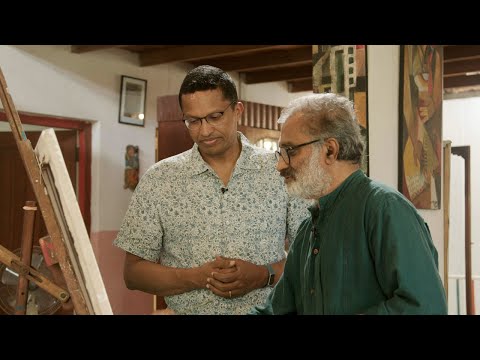
About this episode
An extraordinary journey in tea inspired art, presenting the terroir in tea through vivid colour and an unique refractive style, D. Raja Segar talks tea & art with Dilhan C. Fernando.
Transcript
This transcript was created automatically from the audio and checked for names. Minor errors may remain.
With tea, we talk about tea on the eye, nose and finally the palate, so the visual expression in tea is important, but today we are talking about visual expression at a different level. We are here with Raja Segar, an incredible Sri Lankan artist whose paintings of tea and Ceylon tea have captivated people in the first sense. Segar, wonderful to be here. Good morning, Dilhan. Good morning and we are interested to know how is it that you didn't go to art school, but yet you have developed a unique and applauded style, tell us more and maybe show us more. It is a very coincident that you ask in this question because my career started with a tea plucker, believe it or not.
I used to make some sketches on the tea plantation and tea pluckers and make greeting cards out of that. I was not an artist painter and I sold through the bookshops, S.O.B and it was a big sale, it was a big git because the cards were copied earlier, not the Sri Lankan theme, Western themes copied cards. So I did Sri Lankan tea plucker, tea plantation, everything. I couldn't come up with the demand. So I started to print the cards. Tell me Segar, you developed a very unique refractive style and your paintings are a lot about colour, they are also about the different angles and even though you don't go for the detail in a conventional artwork, you still capture emotion.
Tell us more about that. This is a very difficult question to answer. When you keep on painting, you develop your own style and I forget everything else when I sit in front of a canvas and I speak to the canvas, it's a dialogue with the canvas. The painting that you launched, Australia House last year, was something unique because it didn't show the features of Tonya's face but you knew it was Tonya and you did that through the colour of that signature white dress that she wears, it was something spectacular. Maybe you can show us a little bit about how you start the creative process. I am beginning to do a painting on a canvas.
Usually I take the black acrylic paint on the brush and I make some brush strokes. Can I demonstrate now? Please do. The same old tea pluckers I am making at the beginning of my career. This is the original tea plucker art, is it? Yeah. I think everyone in Sri Lanka knows this because it became iconic for Sri Lanka many years ago and it still is. What is it about tea pluckers and tea that inspired you, Sagar? I admire them. When we go to Kandy, when I drive, I see them both sides and they are really fascinating. In fact, you gave me one very beautiful one on recycled paper and it's beautiful.
I still have it, I think many years ago. You gave this at the tea convention celebrating 150 years of Ceylon tea. Okay, that's it. That's beautiful. That's beautiful. So, Sagar, how did this refractive style develop? I was doing science subjects in my school days and my favorite subject physics and mathematics. So while doing art, I thought I must develop unusual style. So I remember this when the light travels in different density, it reflects. I thought why I should not do this on the canvas. It became my style. I want to talk to you about a painting that you have done more recently on the tea plantations.
Maybe we'll switch the canvases and talk about that a little bit. Tell us what was your inspiration and please explain the colors because you have captured that incredible spectrum of greens on the tea plantation beautifully here. Colors come itself when you start sit in front of the canvas and you take the palette and mix the colors and take it to the brush and apply on the canvas. I don't know how it comes, it comes automatically like the sketches I do because I don't pre-plan anything and I take the, I do the direct brush strokes on the canvas. Now, Sagar, you said you were trained as a scientist, you practiced as an accountant.
Science student, yes. And at a certain point, you decided to make a change. What was the inflection point? Now, as this greeting card sales were doing good, this before the communal problem arise, maybe about 30, 35 years ago, the Sri Lanka was full of tourists everywhere. So my cards became very popular and I couldn't cope with the demand and I had to print the cards as I was doing hand painted cards and it was, they were sold through the book shops, hotel book shops. And one guy bought a card of a shepherd, I mean he taken the bulls at the evening shepherd and he wanted a large painting and he came and spoke to me, he found the phone number behind the card and he came to a different office and he had a chat with me and he said he bought the canvas and I said, sir, I am not an artist, I am sorry, I do only small cards, I don't do paintings, no, no, no.
I need a card but I need a large card, he said, he is very clever. I did the same large card on a big paper, not on a canvas, large watercolour paper, I did the card and after week he came and he took the painting and gave me an end mill up, I didn't talk about the money since I don't know the prices of the paintings and after event I opened the end mill up and it was a huge amount and his name was Donovan and I remembered, I can't forget it, it was the turning point from greeting card to fine art as a painter, serious painter, professional painter.
So I couldn't forget his name, so to honor him I named my son as Donovan, so my son is Donovan now. So Zaga, you are a scientist turned accountant, turned artist, do you think that art and artists are born or that it is something that you can learn? I think art, because I wanted to become a singer, I can't sing, I can't sing, if I will laugh at you. But you wanted to become a singer? Yes, if I will laugh at you, I am full full of singing, so I know it is like, it is very wrong, it is like Albert Einstein said, you can't eat fish to climb trees, so I found out in which I am capable of, so I went through my chemistry books, earlier chemistry notebooks, beautiful sketches, I did, I didn't know, so I continued my sketches and I did steep plantation and everything and I knew that I can paint very well.
So when you stand in front of the blank canvas, the colors come to you, this is what you are saying? No, it depends on the subject, because it means a lot of green, it depends on the theme. You have from lime green through to the dark. Yes, where you put this green and green and blue and this brown, light brown, you get different shades of green, you can get billions of shades of green. What is the difference? It depends how we mix the colors. What is the difference for you in terms of your preference for black and whites or colors? Because I know you do both.
I like both, I like everything, I like watercolor, I like canvas, I like especially, I like canvas because canvas paint is a issued exhibit. You can take a broad, you can remove from the stretcher and roll it and take it. But watercolors you can't do like that, you have to put on a glass frame, generally you can exhibit, which is very costly. So Segar, one of the things about your art, as I explained on the painting of our friend Tonya Shan, you produce faces that have no features yet are incredibly expressive. Tell me a little bit more, maybe show me a little bit more. I will do faces because I don't like realistic painting.
So when I try to do Tonya Shan in detail, she may not like it. So I left it blank for her to decide how her face looked like. And the other thing, we are not seeing these people, so you can paint the faces the way you like. So you leave it to the imagination of the viewer. Segar that's beautiful, it's been really a pleasure talking to you. And I'm so glad I could bring our colleagues and friends from around the world into your studio. It's really been a privilege. Yeah, I'll be very happy and it's a great honor for me that you have come.