Have you ever paired your cuppa with music? 29 min
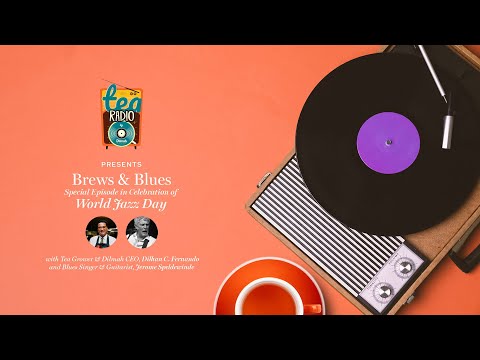
About this episode
Transcript
This transcript was created automatically from the audio and checked for names. Minor errors may remain.
Good morning, good afternoon, and good evening. You're wondering where we are coming to you from. It's International Jazz Day, so Happy International Jazz Day. This is not birdland. It looks a little like it, I know, but it is tea land. So today, we've got something a little different. We are celebrating jazz with the iconic Sri Lankan kruna, Jerome Spaldewin. But first of all, why jazz? You know, we have five sensors, five basic sensors, and each of them are interconnected. Now, any of you who have ever heard the sound of chips in a deep fat fryer, or any of you who have heard the sound of somebody munching a really crisp salad or a great apple or uncorking bottle of fine champagne will know that sound connects a lot with taste or the anticipation of taste.
And so today, we're testing a few theories. And there's a study. This is science. This is the School of Tea. So there is science from the Oxford University, no less. What it says is that sound is connected with the perception of taste, multi-sensory perception, to give you the proper word. And so how it works is that deeper notes, they enhance more intense flavors, bitterness, the lighter, softer audio notes, flutes, some strings on the violin. They enhance the perception of sweet and savory. Is it true? I think it is. Anyone who knows, if you've eaten fish by the ocean and you've heard the sound of the ocean, doesn't it make the fish taste better?
That's all to be tested. So to test it with me, I have one of Sri Lanka's most famous jazz musicians, and I'm delighted to introduce Jerome Spelderman. Now, he's coming on right now in a minute, but before that, I have a question for you. It is International Jazz Day, so I have to ask you this question. Do you like jazz? There's a poll out there. Tell us what you think. So far, it's all yes. Oh, my goodness. There's a couple of noes. There's two noes. Okay. Well, let's hope that at the end of this session, we're going to make you really enjoy jazz. Why? Because of the connection between tea and jazz.
And in the same way, tea has an incredible connection with classical music. Tea has a fabulous connection with pop, maybe not with some types of rock, but everything is subjective, right? So with that, I want to welcome Jerome Spelderman. Jerome, welcome. Great to see you. So Jerome is chilling out by the beach all the way on the other side of Sri Lanka. Welcome, Jerome, to the virtual session of the School of Tea. Thank you for having me, Dilhan. It's a pleasure to be here. Good to see you. So we're going to be testing this theory. Now, like I said, it's no less than Oxford University that has talked about the connection between the sound and the audio, the pitch and the perception of tea.
So we've got a few teas, and we're going to start with a classic. We're going to play a few seconds, and then I'm going to talk a little bit about the tea, and then it's over to Jerome to tell us what he thinks, because he is the pro in this session. So, colleagues, Blue Moon. You saw me standing alone Without a dream in my heart Without a love of mine Blue moon, you knew just what You heard me saying a prayer for Someone I really could care for Now, that is a classic. It is beautiful. So, I paired that with one of our teas from the low elevations.
It's got intensity. It's called the yatta-watta-yatta, lower elevation. And it's got the intensity, because here you've got a lower pitch, you've got a beautiful, beautiful audio, but it's not light and bright by any means. And you need to match the tone of the music with the tone of the tea. What do you think, Jerome? Did you enjoy that track? That was a good start with Billie Holiday and Blue Moon. Billie Holiday epitomizes the female jazz thing, although I'm a bit of an Ella Fitzgerald fan. Can you hear me over there? Yes, it is perfectly. And we have Ella Fitzgerald coming up. Yeah. I mean, Billie Holiday, Blue Moon, it's sort of synonymous with jazz.
It's like Louis Armstrong and whatever he, and his trumpet playing and stuff like that. It's a beautiful, beautiful song. Tell us a little bit about the origins of jazz, Jerome. The origins of jazz, I'd say, came from New Orleans. I said New Orleans. If you go and say New Orleans, they get very upset over there, apparently. So, New Orleans, and there's that French connection. There's a bit of a dispute as to who actually came up with the concept of jazz.
Some people say a guy called Jelly Roll Morton, who was a strike piano player from New Orleans. And WC Handy was another gentleman that claims to have started jazz. He wrote things like St. Louis Blues, I think. Anyway, so there's a strong French connection in jazz because it came from New Orleans. Well, I think with that, maybe I might take you to something a little brighter because I know you're in a beautiful place. From what you told me, you're in Arugam Bay. So we're going to move from this deep, brooding intensity and Billie Holiday to something a little different. So this time, we're pairing this track.
We're not allowed to play the whole track because of copyright. You know how that works. But we're pairing it with a beautiful English breakfast. Now, here you have a bright, it's bold, woody, a little bit of cedar, a breakfast tea from the Dimbula Valley. And I'm going to ask my colleagues to hit it. We've got Cantaloupe Island, which I know you love. So, you know, with that bouncing along, it's a beautiful track, isn't it? It's a beautiful track written by Herbie Hancock. And it goes well with the English breakfast. I'm sure it would go down like a hand in glove. Tell us a little bit about Herbie Hancock, Jerome.
Herbie Hancock started off with Miles Davis, I think, in that electric band that he started off with. And he actually, as of this moment, he probably is one of the brightest and the best spaces in jazz. Herbie Hancock is a musical director. I mean, I saw the thing about three years ago at the Obama White House where they had the International Jazz Deaf Concert and some fantastic artists. Kurt Elling and other beautiful vocalists that I love was there. And Herbie Hancock was the musical director of that whole event. And so, you know, he's fearless in a way. So you mentioned your favorite jazz musician. Yeah. With that, I'm going to leave the introduction of the next track.
Not the introduction, but I'm going to play the next track and then I'm going to ask you to talk about it. But I'm going to introduce the tea first. So this next track, which I'm going to leave it to you to talk about, is paired with a tea from the Udupo Salawa region. It's bright, it's got medium intensity, and it's got a little bit of bitterness with Italian almond. And it's an incredibly fragrant tea. It's fabulous, and it perfectly suits your favorite musician. I'm going to ask my colleagues to play it now.
Wasn't that incredible? Tell us a little bit. Fantastic. Louis and Ella, it doesn't get better than that. Really, it does. And the brightness, you know, that's a track that has incredible depth and it is so emotional. And we paired it with this tea because this tea has brightness and you have the combination of Ella's incredible voice with Louis' inimitable... Louis Armstrong, some people say he was the father or the grandfather of jazz. How does that work with some of the names you mentioned at the beginning, Jerome? Yeah, there's that... I mean, you know, Michael Lund actually wrote this book a long time ago, which is like one of the most definitive books on jazz, actually.
It was called Coming Through Slaughter. And it's a story about a guy called Buddy Boulder, who was a coronet player trumpeter in New Orleans. He's one of these guys who was never recorded. So then he used to play at funerals. You know, funerals in New Orleans were like a big event and they said that you could hear him. It was so loud without any amplification. You could hear him like three or four blocks down. So Louis Armstrong comes from that tradition. So, you know, like he, you know, when he blows that trumpet, he blows hard, you know, and you can see the expression on his face and I mean, he epitomizes just about everything that is jazz, the improvisation, the tonality.
I mean, I told you Wynton Marsalis just says there's only one word for jazz and that is jazz and that is Louis Armstrong. Beautiful. Now, you've got a guitar around your neck. I play a guitar basically to accompany myself. I just like singing all these songs. You know, they're like jazz standards. There's about four volumes of books written by all the great composers from Gershwin to Cole Porter to Irving Berlin. I mean, it comes from Tin Pan Alley. Most of these songs that are performed come from some sort of musical that basically came out of New York City Broadway. So these composers wrote these beautiful pieces of music basically for Broadway stage plays.
And that's basically what makes up the jazz songbook. And now it's expanded to, yeah, more like obscure, out there kind of compositions, yeah. But jazz is so very different today, isn't it? What do you think about contemporary jazz? Well, you know, jazz is a large umbrella. There's a lot of things that come under jazz. It's like when Stan Getz went to Brazil and then did the Brazilian thing. So there's a Brazilian connection. And then I think some of the greatest exponents of jazz and musicality are the Cubans. I mean, there's something else, those guys. But they also have a strong passion for jazz because they like the improvisational factor of it.
And like Louis Armstrong or Ella Fitzgerald in Dream a Little Dream of Me, rather than sing, she just does a scat. It's freedom of expression, poetic license, all that sort of stuff. So that's what jazz is, it's freedom. What's your favorite riff? My favorite riff, in a sense, my favorite riff is probably a rock riff. It's a smoke on the water. You know, I've got to tell you the story. Someone said to Ritchie Blackmore and he said, you know, this jazz is the most famous rock riff. And then Ritchie Blackmore said to this guy, and what about classical music?
Not on World Jazz Day, Jerome. What's your favorite jazz riff? My favorite jazz riff is probably, again, Herbie Hancock's Watermelon Man.
It's funky, you know? We're going to have to meet when we can actually hear some of your music next time. And that would be awesome. That would be amazing. But now we have a question for the audience. We're going out live on Facebook plus on Zoom. And so to the audience, we want to ask you, what genre of music would you pair with your kappa? So we've got pop, jazz, classical, nothing, and anything. Tell us. Jazz, okay, mostly jazz, anything. That's good. Pop, yeah, you, brilliant. You know, for me, like with tea, you should never have a favorite tea. You should love all tea and appreciate each for its own characteristics, aroma, taste, texture.
And I think the name of music, I love classical. I mean, Jerome, do you agree? You shouldn't have a favorite music? No, you shouldn't have any genre bias unless it offends you. Yeah. Well, some do, but, you know, not on international jazz day. We've got to talk about all the good stuff today. So for me, there's a few genres that do offend, particularly the stuff with the E on iTunes and Spotify and all this kind of stuff. The explicit stuff, you know, I don't see the sense in some of that, but that's personal. So now we're going on to the next tea. Sorry, Jerome, you were saying something.
I was going to say that jazz in that way, it doesn't discriminate genre-wise, you know. It's just its own form of music. And if something grates on you, you just don't have to listen to it. That's all it is. You know, it's all, what do you want to put in? It's like you say, what do you want to put in through your mouth as far as tea goes? What do you want to put in through your ears as far as music goes? But also, you know, jazz to me is a lot like rugby in sport. It's intense, it's sometimes quite aggressive, but yes, it's elegant and it's beautiful.
I love that about rugby too. Okay, so you know, well, the difference between rugby and football, but for the football fans, anyone who's listening, nothing against anything, like I said, never have a favorite, appreciate everything for what it offers. The skill. So we're going to a completely different style.
Blueberry and vanilla. Why? Because it's soft, yet it's, of course, autumn is beautiful and it's soft, it's gentle, it's got incredible presence and that's what this tea has. Tell us a little bit about the track, Jerome. It's one of the tracks that if you get into jazz, initially, it's one of the tracks that people would suggest that you do. So to be honest, we have sung autumn leads many times in different grooves as such, as a chart, as a bossa, as a swing thing, as a ballad. There's a Chet Baker. Chet Baker is another guy who is just something else. And his vocal style is something that I really admire, Chet Baker.
He's so true to the note and autumn leads is a, that I think he's a French song as well. And yeah, recently I heard Bob Dilhan do autumn leads. Believe it or not, he was a fantastic version of it and he does an entire album of American jazz standards and his version of autumn leads is something else. And he kind of lingers, doesn't it? It's a song that can never offend. It haunts you. Yeah, it's beautiful. So well, that was that one. And now he haunts you too. So we're going to a completely different continent and we're going to listen to something. I think I've heard you sing this, I might be wrong, but the girl from Ipanema, which is one of my favorites.
I'm going to sing this.
Antonio Carlos Jobim was a struggling musician who went to Ipanema Beach and word has it that he saw this woman on the beach and he started writing this tune. And a few feet away from him was this other guy called Vincenzo Moraz, who was a poet. And so Antonio Carlos Jobim walked up to him and said, what are you doing? He said, I'm writing some poetry about that beautiful woman on the beach. And Chobim said, well, I am writing some music and that's how this song came into being and it's probably the most popular elevator song as well as some people would say. But it's great. It's always a great piece of music.
The choral movement in Chobim songs or something else and the sensuous flavor and the lyric and the language, the Portuguese language is something else. It's one of those songs that you have to really listen to on good equipment to capture the different layers, the depth that it has. And what we have done is we've paired it with something quite different because it is that lilting, it's kind of dances along and we've paired it with our Moroccan mint green tea, which also dances along on the palette. Yeah. Now, we come to the next, which this is another classic. I don't need to introduce this track, but all I need to tell you is that it's paired with this spectacular oolong.
What a classic. Tell us a little bit about Nat King Cole Jerome. Nat Cole was probably the most played artist on a radio salon in the 60s. And that song in particular and things like Mona Lisa, which some people might say, well, they're more popular songs rather than being jazz classics because there are the spirits who only think that bebop, for instance, is what jazz is about. But Nat Cole was a fantastic piano player. I mean, they started with the Nat Cole trio, Charlie Christian and the bass player, but it was just a trio with a guitar and a bass. Nat Cole trio and did things like, he did that, that, that, that, that, that, that, that, T for two.
That was a beautiful Nat King Cole song and people like to listen to a definitive version of that song. It's Nat King Cole or the Nat Cole trio playing T for two. Fantastic. My favorite version of Unforgettable is when Natalie Cole says along to, of course, done, I believe was a Nat King Cole type. Much, much missed actually, Natalie Cole. Beautiful track. So that we've paired with this beautiful Oolong. Now this is a springtime Oolong because it's light. It's a contrast with the lower pitch of that beautiful song. So we have a poll. Do we have a poll? No, we don't have a, we have a poll.
Yes, we have a poll. Have you listened to the only T-inspired radio station guests? Tea Radio. If you haven't, you can. Tell us if you've heard of Tea Radio. Oh, you have. Okay. Some have, some haven't. Well, check it out. We'll put up a link in a little while and thank you and you can publish the poll. Publish the poll. Thank you. Share the results. Great. Thank you. So many have heard, but you know, what we're going to do is we're going to, we're going to do a few pieces on jazz, on, on Tea Radio, but that's coming up later in the day and in a separate session.
So I think with that, we're going to move to wrapping up. So let's see the next slide. So, you know, what we've, stay on, please, Jerome. I still need you for a minute more if you don't mind. So, you know, why Duke Ellington? He wasn't in the original lineup. Well, we've got Duke Ellington because I learned from the U.S. Embassy's Twitter post a little while ago that he had visited Sri Lanka in 1963. I never realized that. I played at the Oval. At the Oval? At the Oval, at the Pisara Oval. Fantastic. I was not very eligible as such to go to the concert, but I remember this event, Duke Ellington coming.
I saw video of him, or rather pictures of him with some drummers, Sri Lankan drummers, and apparently they had a jam session. That must have been mind-blowing. And I'm sure, I'm sure. No recordings. You'd have really been into it. I mean, Duke Ellington was one of the most unheralded composers, but then he had an accomplice with a guy called Billy Strayhorn, who didn't want that much publicity because of his status and whatever. He, yeah, Billy Strayhorn wrote a lot of stuff like Take the A-Train. He apparently wrote Take the A-Train while he was traveling on the A-Train to meet Duke Ellington in Harlem. And he handed him this piece of music.
So, but you've got Take the A-Train. That is like synonymous with Duke Ellington. That's going to be our next show. But before we wrap up, what's coming up next? Well, next month, my father's 91st birthday. And Jerome, we're going to have him on social media. He's doing a social media takeover from tomorrow. And so he's having a virtual global tea party. You know, we've got to be careful. So he's in isolation. So he's not too happy. But still, we're using Zoom to connect him with the world, to celebrate his birthday, and he'll be on the next session. That's coming up on the 6th of May. That's his birthday.
And on the 12th of May, celebrating a handcrafted journey. So before we move on, we have a poll. So I want to ask, how did the session go? Did you guys think that tea and music, is it a good idea? Maybe not. Maybe we try something else. Well, I know everyone loved Jerome. But the idea, okay, mostly, yes. Well, 91%, yes. So that's brilliant. Jerome, you have been an incredible guest. Thank you. Thank you for having me. I'm really honored that you joined. And thank you so much to your technical assistant, who I know is somewhere. Can we see her? Sharon, come on. Can we see you for a minute?
Is she there? Yes. Sharon? Yeah. Sharon, she's hiding. Okay. Yeah, he's not done. Oh, okay, okay, okay. Anyway, and congratulations and many happy returns to your dad. I'll pass it on. You're a wonderful man. And the Dilmah people have always been great sponsors and benefactors of the arts. And that's very much appreciated, I know. Thank you, Jerome. And I look forward to seeing you in the flesh. Thank you for this session. And with that, we are going to conclude with Take the A-Train. Jerome, stay safe. Have a brilliant weekend. Have a great weekend, everyone. Thank you for joining us. Bye-bye. Thank you.