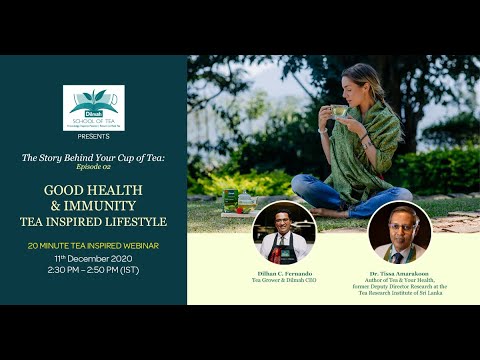
The Story Behind Your Cup of Tea – Episode 2: Good Health & Immunity – Tea inspired Lifestyle
About this episode
Studies have found that theanine and polyphenols found in tea can boost your immunity, while antioxidants in tea can help fight non-communicable diseases. In case you missed our “Good Health & Immunity – Tea Inspired Lifestyle” – Episode 02 from our Story Behind Your Cup of Tea webinar series, watch Tea Grower and Dilmah CEO, Dilhan C. Fernando and Dr. Tissa Amarakoon; author of Tea & Your Health, former Deputy Director Research at the Tea Research Institute of Sri Lanka and currently Senior Lecturer in the Faculty of Science, University of Kelaniya discuss the goodness in your cuppa!
Transcript
This transcript was created automatically from the audio and checked for names. Minor errors may remain.
Welcome back. We're at the School of Tea. We're talking tea, as you know, but this time we have something very special for you. You know, tea began as a medicine. It was that that it was revered for in ancient China. And today, when we're all facing problems with human health and wellness, tea has a very special relevance. And so I have someone who is an absolute expert in this, author of this magnificent book, Tea and Your Health, and also scientist, researcher, and now continuing his work at the Kalani University, formerly of the Tea Research Institute. Dr. Tisamrakoon is an authority on the subject of the health benefits in tea. So to begin with this, sir, I'm going to pour you a cup of tea, because that is critically important. But I would like to ask you, I know you answered this question earlier, but how many cups of tea do you drink? Usually, I don't count the number of cups that I drink, but obviously, more than six, maybe around 10 cups a day. So that's
the secret to your health and vitality. So this, you know, from the time we are kids, our parents tell us, eat your vegetables, eat your broccoli, and so on. Tell me how does tea drinking, in terms of its antioxidants and human health benefits, how does it come fair with eating our fruits and vegetables? Yes, when it comes to antioxidant activity, we know that antioxidant activity can improve our health. And also, it can reduce the risk of certain diseases like heart disease, cancer, diabetes, etc. And if you measure the antioxidant activity of tea in one gram, it could be around 1000 units. And if we measure the antioxidant activity of vegetables and fruits, generally, it's around 100 units per gram.
So you can see, tea contains more antioxidants compared to fruits and vegetables. And also, all types of tea have similar antioxidant activity. From sample to sample, there may be differences. But generally, all types of tea have very high antioxidant activity. But this is when we measure the antioxidant activity in vitro. That means we are doing it in a test tube. But the important thing is, what happens when we drink a cup of tea, whether it's absorbed into our body. And then after that, whether it has antioxidant activity inside our body. And also, if antioxidant activity is there, whether it's acting beneficially. So when it comes to this type of research, a lot of research has been done on tea.
About the in vivo antioxidant activity that is antioxidant activity inside the body. And also whether it helps in reducing the risk. But when it comes to other fruits and vegetables and also herbal products, the amount of research done is relatively less. When it comes to tea, we know definitely that it can improve our health. And also, it can reduce the risk of certain diseases. And the other important thing is this antioxidant activity is due to flavonoids in tea. And interestingly, the quality of tea is also directly related to the amount of flavonoids. So that means if the quality of the tea is high, then obviously the health benefits are also high.
So this is what you're saying is that green, black, oolong and possibly silver tips have similar antioxidant potential or similar goodness? Yes, as I mentioned previously, there can be differences from sample to sample. But we can generally say all those have similar beneficial properties. And silver tips, it has something a little bit more, doesn't it? Yes, when it comes to silver tips, we pick only the bud. So when it comes to bud, generally we pluck the bud first tip and the second leaf. And with leaf maturity, the amount of flavonoids are decreased. So if you pluck only the bud, then the antioxidant activity and other health-promoting properties would be high.
Well, this of the last few months has enhanced our desire to find out what is natural and good for us and look at natural ways in which we can enhance our immunity and human health. So this has all been spurred by the public health crisis in the pandemic. How does tea fit into this new desire for a healthy lifestyle? Yes. Nowadays, we are looking at ways to improve our immunity. So we know that the diet has a direct relationship with the immunity. That is, there are certain dietary items which can decrease our immunity and certain dietary items which can increase our immunity.
High amounts of carbohydrates, especially refined sugar and alcoholic beverages. And although not a dietary item, tobacco products and smoking can reduce our immunity.
And research had shown that products coming from plants can improve our immunity. Then further research had been done and they have found that flavonoids in plants are responsible for the improving of the immunity. So the important thing about tea is all plants have flavonoids, but tea has uniquely high amounts of flavonoids compared to others. So because of that, we can say tea can improve our immunity also. Well, this, you talked about handpicking. Now, something my father always told me is that you can innovate, you can go with the 21st century trends. But in tea, conservative agricultural practices, keeping the tea pure and tradition is critically important because it also makes our Ceylon tea more expensive. So in that context, isn't our tradition in Sri Lanka of handpicking and the artisanal manufacturing, isn't it also important for human health or is it not? Yes. As you mentioned, in Sri Lanka, when we produce tea or when we produce Ceylon tea, we use orthodox methods. And here we combine the science and art of tea making.
If I take an example, in Sri Lanka, there are different tea growing regions with different climates. And because of these climates, unique types of teas can be produced. But our scientists and also the tea growers use methods to enhance this quality. For example, the Tea Research Institute of Sri Lanka recommends certain tea varieties for each region and also different fertilizer mixtures. So like this, they recommend certain things for different regions. And at the same time, when tea is grown, they experience plantless or the managers of plantations, they use the time-tested methods and which they can vary according to the season. And not only that, when you take the leaf into the factory, they experience tea maker also use orthodox methods, which can be controlled by him according to the situation. So because of that, we can produce in Sri Lanka, different types of unique teas in different regions, which cannot be produced in anywhere else in the world. So the quality of these teas are also very high. So as you mentioned,
we use orthodox methods, which are time consuming and also laborious. So because of that, the cost would be high. But I would say this is amply compensated by the high quality of different types of tea that we produce, which can satisfy the effect of any consumer in the world. And as I mentioned previously, always quality of tea is related to high flavonoid content. So because of this, we can say this high quality tea will have better health-promoting properties. So this in some countries, not in Sri Lanka, fortunately, there is a tendency towards large scale machine harvesting using these self-calibrating machines and so on. Here, I think the limit is shears, which are still a very manual artisanal process. So what you're saying is that would also influence the quality and the natural goodness. Yes, definitely. Because as I mentioned, the good compounds, paveroids and other good compounds are concentrated in the bud and the two topmost leaves. So when you do the hand plucking, you can selectively pluck only that
part of the bud. But if you do a machine plucking, you can't do that. If you pluck even the mature leaves. So definitely hand plucked tea, the quality is better and also health-promoting properties are better. So you and I know that a good cup of tea needs to be fresh and perfectly made. Now freshness, the concept of freshness in tea in a dry product is very different to what people understand in the case of fruits and vegetables. So can you tell us a little bit more about that? Yes. As you mentioned, when it comes to freshness in vegetables and fruits, in about two or three days, it will deteriorate. But as you mentioned, tea is a dry product. So the quality will not deteriorate quickly. It will take some time.
But the important thing is tea can absorb moisture very quickly. So if you expose your tea to the environment, moisture will be absorbed and it will deteriorate very quickly. So generally in about three months, tea will not have the same taste. So what happens with most tea suppliers are, what they do is they will collect tea from the factory in bulk form and then transport into seaports and then they will ship them to the destination country. And there also they will do blending operations with teas coming from different countries. And all these, when we do these things in bulk and also it takes more than three months for these operations to take this, then only they will pack the teas. But instead, if you pack your teas at the source, like to do in Dilmah, then the freshness will be retained and you can easily keep the teas for more than three years. And again, I would like to mention, if you retain the quality, that means health benefits will also be retained in the tea.
So we talk a lot about tea being hygroscopic. Can you add some light to that? Because not everyone understands exactly how hygroscopicity works. Yeah, hygroscopic means it can absorb moisture very easily into the tea particles. So the moisture level goes up, not only moisture, tea can absorb other compounds in the environment also. So different smells can be absorbed. So because of that taste and for example, if toxic compounds in the environment is absorbed into tea, then there will be toxicity. So the best option is to pack it properly at the source. So we've also talked about L-theanine and other compounds in tea having its ability to enhance mood, enhance alertness and so on. Now, particularly in the situation that the world is in right now, anxiety and stress and worry are all issues. You talked a little bit about the impact of tea on human health in relation to stress, but tell me a little bit more about this impact on mood.
Yes, there are two compounds in tea which can have an effect on our brain. Those are caffeine and tea. If I first talk about the short term ethics, caffeine we know it's the well-known stimulant. It will stimulate you and it will make you alert and also it will reduce your tiredness. And theanine is found only in tea. It's not found in any other plant. So this unique combination of caffeine and theanine is found only in tea. So the short term effects of theanine is relaxation. And it is important to note that theanine can relax you while not making you drowsy or sleep. This is very important because we know even most of the drugs, even for relaxation, it will induce sleepiness. So this is very important. So as I mentioned, caffeine can make you alert. So for example, if you are working, you can work at a faster rate because of caffeine. But we know when we try to work at a faster rate, we tend to make more mistakes.
But theanine in tea can compensate that. And research has shown when caffeine and theanine are present together, you can work faster and more accurately. So this means obviously tea would be an ideal drink to take while you are working. So that is about the short term effects. Then recently, a lot of research had been done on the anxiety, stress, and also quality of sleep. And again, theanine is responsible for mostly these things. And this research had shown that regular tea drinking can reduce the anxiety, stress, and also it can improve the quality of sleep. In these experiments, they have actually monitored the brain status while the individuals who underwent this research were sleeping, measuring the electrical conductors and also the magnetic environment in the brain. So it has shown that sleep quality is improved.
So this is very important because some people have the perception that if you take a caffeinated drink in the night, then your sleep would be affected. So according to this new research, we can say that sleep quality is improved by tea because it contains both caffeine and theanine. And another interesting observation is you have at least consumed tea for about 12 weeks to have these positive effects. That makes me want to reach for another cup of tea, yes sir. But before I sip on that, there has been a lot of talk about the importance of gut health to ward off chronic diseases, different ailments, in fact, to improve sleep and so on. Now, what is the impact of tea in terms of your digestion and generally gut health? Yes, we know one thing is through our digestive tract that is starting from the oral cavity that is mouth up to the colon, a large number of that is millions of microorganisms live. And some of these microorganisms
are beneficial to us while some are harmful to us. And there's another group which are neither harmful nor beneficial. And research had shown that long-term tea drinking can reduce the harmful microorganism populations and at the same time increase the beneficial microorganisms. So if I take some examples, for example, in the oral cavity, the tooth decay bacteria can be reduced by regular tea drinking. And also certain fungal species like Candida, which cause inflammation in the oral cavity, also can be reduced. And when it comes to the intestine and other parts of the digestive tract, the research had found that most of the inflammatory bowel diseases can be reduced by regular drinking of tea. And another important finding is regular tea drinking can reduce the bacteria, helicobacter pylori. So this is the bacteria which mostly contributes to gastritis. And also another thing is when these harmful microorganisms are present in our digestive tract, eventually these inflammatory diseases can develop into cancer.
So again, research had shown that regular tea consumption can reduce the risk of cancer throughout the digestive tract. This recent US study talked about the potency of plant flavonoids, particularly in tea, and the potency in inhibiting the development of COVID-19. Does tea drinking strengthen our ability to ward off coronavirus? Yes, this research are still at the initial stages. But we know when a virus enters our body, it multiplies. So this is the problem. If it does not multiply inside our body, our immune system can deal with the viruses which have entered. It can destroy them. When it comes to a virus like coronavirus, which caused COVID-19, the problem is we would be exposed to that virus for the first time. So it will take some time for our immune system to organize the defenses and attack against this virus.
So by that time, the virus had multiplied into millions and millions of new viruses. Then our immune system cannot cope with the situation. So this is where the vaccines also come in. A vaccine can accelerate the action of our immune system and destroy the virus. And the other approach against viruses are antiviral drugs. And these antiviral drugs also does not try to kill or destroy the virus. Generally, most of the antiviral drugs try to stop the multiplication of the viruses. So there had been initial research, initially using computer modeling to find whether plant flavonoids can reduce the multiplication of the viruses, especially this COVID-19 virus. And they have tested a very large number of flavonoids. And then out of this, they have found that the T flavonoids have the best activity. And according to this particular research, tear flavin in black tea has the highest activity. And so these are computer modeling studies. And they have gone to the next stage where they test this in vitro. And again, they have found the same results.
That means T flavonoids are very effective in stopping the multiplication of the COVID-19 virus. So this research has to go a long way before we can come to exact conclusions, because in vivo studies has to be done. But based on these results, and also I mentioned previously that tea drinking can enhance our immunity. So because of these facts, we can say regular tea consumption may have an effect on the COVID-19 virus. That's amazing news for tea drinkers. Sir, thank you. And possibly with your insight on mood altering and energy generating impact of tea, we should probably, with apologies to our friends in the coffee industry, maybe also occasionally reach for a cup of tea in the morning instead of the restrecto that many Europeans do. Thank you for joining us.
Join us at the Facebook, the Dilmah Tea Club on Facebook, where we'll answer the remaining questions. There are many, and we will answer each of them. We will also share the links and the different details we discussed last week, the last month and this time. But until then, I want to wish you a Merry Christmas. I also want to wish you a tea-inspired Christmas. Remember, tea was born as a medicine. Today, it's a beautiful beverage. I hope that Dr. Tissa mentioned. But it's also something that's really good for human health, and that's scientifically proven. If you want a copy of this, we will share the link where you can pick one up.
But until then, I would like to thank Dr. Tissa, who's extremely humble in his expertise and a wonderful person in sharing his knowledge. Thank you, Dr. Tissa, and thanks to each of you. Have a wonderful weekend, and in case we don't see you before then, have a blessed Christmas.
More episodes
All episodes
The Story Behind Your Cup of Tea – Episode 3 : All I want for Christmas is my Tea inspired Cocktail (or Vegan Mocktail)
Watch Transcript