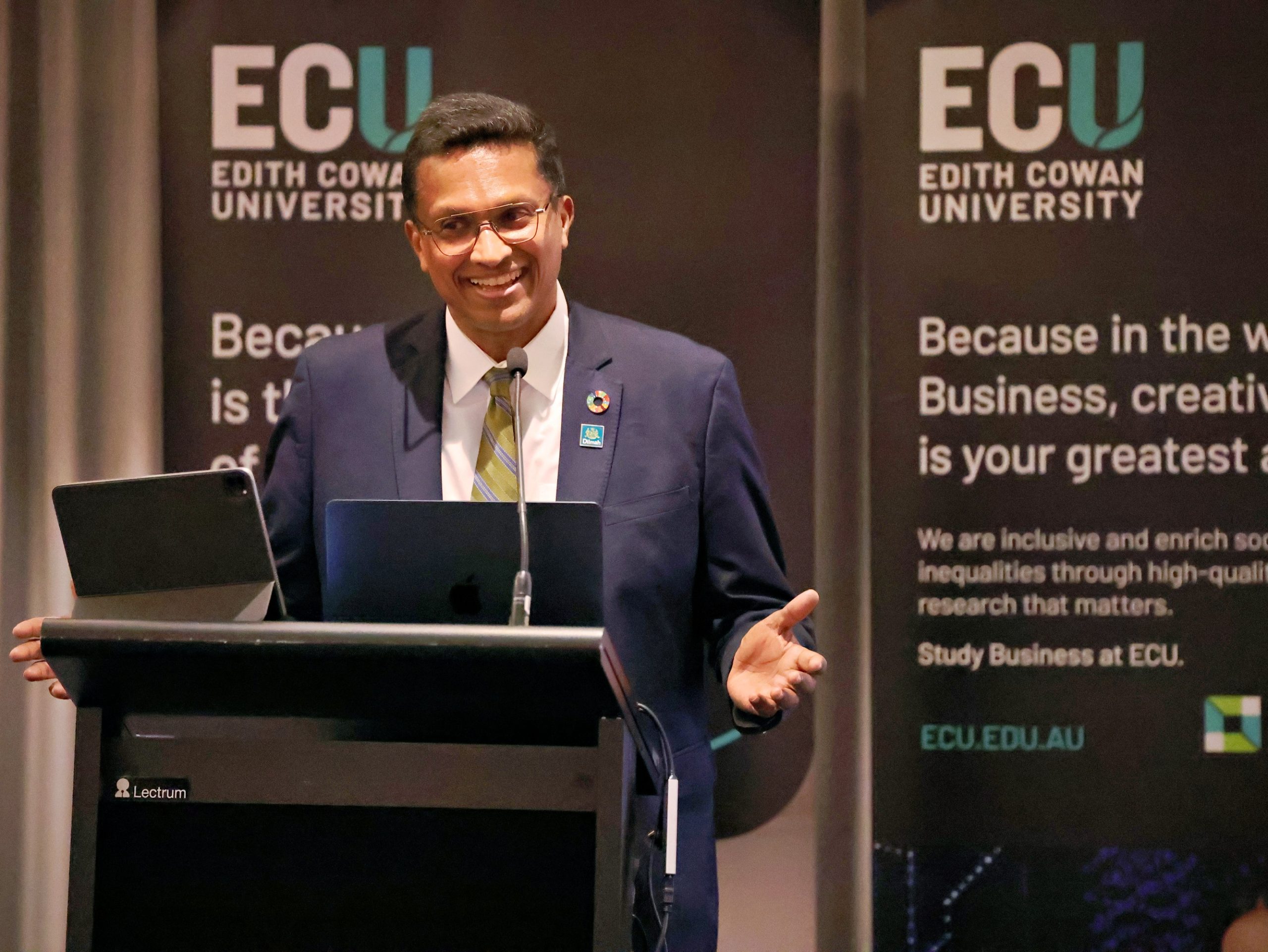
In the one place in the world where I am honoured to be known as adjunct Professor of Sustainability and Doctor of Business (Honorary), I was privileged to offer suggestions on aligning profit with social impact. My presentation on 1st July, 2026 at an event hosted by Edith Cowan University in Perth, Western Australia, to an audience comprising Australian businesspeople and academics follows.
Eighty-five seconds to midnight.

That is where the world’s most eminent atomic scientists including several Nobel Laureates set the Doomsday Clock in January this year — the closest to catastrophe in its 79-year history. Closer than the Cuban Missile Crisis. Closer than any single year of the Cold War. They did not move it for one single reason; they moved it because the institutions we built to manage shared risk — on climate, on conflict, on technology — are pulling apart at exactly the moment they need to pull together. [Bulletin of the Atomic Scientists, 2026]
Let me give you a second number.

Ten years ago, every nation on earth signed seventeen goals to end poverty and protect the planet by 2030. We are five years out. The United Nations’ own 2025 assessment finds only 35% of the targets on track. Eighteen percent have gone backwards — not stalled, reversed. The Secretary-General called it, in plain language, a development emergency. [UN SDG Report, 2025]
Neither a politician nor a banker, I am a tea grower. I work with soils, rainfall, people and supply chains. And I want to tell you that these two numbers are not someone else’s problem. They describe the ground we are already standing on. The symptoms will sound familiar — fractured trade, fractured trust, elevated risk, all hitting us faster than our institutions can absorb it.
Here is what 36 years in our family’s business has taught me, and it is the heart of everything I want to say today: the gap left by failing institutions does not stay empty. It gets filled — by someone, or by catastrophe. And the entity with the mindset, speed, capital and reach to fill it well, right now, is not government. It is us, businesses.
I want to be careful how I say this, because I am not here to preach. I am here to make a business case, every word burnished by my family’s own experience and direction. The argument is simply this: in a fracturing world, the company that aligns its profit with the health of the people and the natural systems we all depend on, is not the charitable one. It is the resilient one. It is the one still standing after the shock. That is not idealism. As a grower, who – without compromising people or planet – survived the series of social and economic crises that Sri Lanka endured in the last decade, I assure you, it is our most practical reality.

When global co-operation breaks down, the cost shows up first in your supply chain, your insurance premia, your cost of capital and so your cost of goods, services and doing business.

The Gulf is in crisis. An unpredictable conflict around the Strait of Hormuz pushed oil prices above a hundred dollars a barrel, one of the sharpest energy shocks since the 1970s. Container lines are rerouting around the Cape of Good Hope, adding weeks and cost to every voyage. And because the Gulf produces close to half the world’s urea, fertilizer prices have jumped — that lands, in the end, on every farmer, every harvest, and every food bill, including here in Australia.
That only adds to the cost of living pressures imposed by the climate crisis. The UNDP expects tens of millions of people globally to fall into poverty as a result. And that is before the expected impact of El Nino, which is just weeks away. The compound shock of both is likely to affect every nation.
A generation ago we would have called the Gulf conflict a once-in-a-decade crisis. Today it is one of 100 armed conflicts happening right now (Geneva Academy). A pandemic that demonstrated the power of harmony, then war in Europe, then the Red Sea, now the Gulf — the shocks are no longer the exception that interrupts business as usual. They are the business as usual.
This is our operating environment.
And once you accept that disruption is the norm and not the anomaly, the whole calculation changes: resilience stops being a cost to be minimised and becomes the core of the strategy. The fragile supply chain is no longer merely risky. It is, predictably, going to break.
Australia does not trade in a vacuum. Your prosperity is wired into Southeast Asia — your food exports, energy, minerals, manufacturing inputs all move through the value chains of this region. The Asian Development Bank, in its 2024 study of ASEAN value chains, named climate change as one of six mega-challenges that could upend the entire production network the region — and Australian business with it — depends on. Its message is blunt: value chains that do not decarbonise and build resilience will not survive the shocks now coming. This is not advocacy. It is a development bank telling firms to future-proof or lose their place in the network. [ADB, 2024, ASEAN and Global Value Chains: Locking in Resilience and Sustainability].
The OECD, in its 2024 report on Southeast Asia, puts a human number on that risk: more than 100 million workers in this region hold jobs directly tied to the environment. When climate shocks hit those workers, they hit the base of the supply chains that feed your shelves and stock your factories. Southeast Asia has already lost 15% of its forest cover since 1990, mostly cleared for agriculture — degrading the very systems production depends on. [OECD, 2024, Towards Greener and More Inclusive Societies in Southeast Asia].
And do not imagine this is only a story about your neighbours. It is a story about your own coastline. An obvious example – the Great Barrier Reef contributes around nine billion dollars to the Australian economy every year and supports 77,000 jobs — if it were a company, it would be your fifth-largest employer. A new Deloitte assessment last year put its total value at 95 billion dollars, and warned that it will not endure without urgent climate action. [Deloitte Access Economics, 2025].
You have lived the rest of this already — the Black Summer fires, the floods that have hit the eastern states year after year. The cost of a destabilised climate is not a projection for Australia. It is a line item you are already paying.
Here is where it reaches the balance sheet directly. Your regulators — APRA and ASIC — have both made it explicit that climate risk is financial risk. That means it shows up in the price of insurance, which is already climbing or withdrawing from exposed regions. It shows up in the cost of capital, as lenders and investors price transition risk. And it shows up in the value of assets that may not survive the shift.
A business built on degraded soil, exploited labour and a warming climate is a fragile asset, and the market is learning to price it that way. A business built on the opposite is the one still standing after the shock. As a grower, I can tell you which one I would rather own — and increasingly, so can your bank.
Now hold all of that against the same reports’ other finding — because this is the pivot the whole discussion turns on. The OECD calculates that in Indonesia alone, the shift to cleaner energy could create more than one million new jobs. That expanding organic rice to just 5% of the region’s farmland would generate over five times more jobs than the same expansion of conventional rice. [OECD, 2024]. The transition is not the cost. The transition is the growth. The only question is whether you are positioned to capture it or exposed to its absence.
Let me make this concrete with the example I know best — my own family’s business. But first, let me tell you how a grower sees the problem. In December last year I sat in a room of tea growers from Sri Lanka, Kenya and India. Tea is the most consumed drink on earth after water — five billion cups a day, with real, measured value to human health. The entire world’s tea is grown on about 5 million hectares — a footprint smaller than Costa Rica — yet it sustains tens of millions of livelihoods and half the planet drinks it daily.
And yet every grower in that room shared the same fear: the price we are paid keeps falling, even as the value of what we grow keeps rising. That gap — between value and price — is the most dangerous number in global business, and almost no one tracks it. The same pattern runs through coffee, cocoa, cotton. The value is captured downstream, in branding and distribution; the grower, who carries the climate risk and tends the soil, gets less and less. [Kiel Institute; DMCC Future of Trade, 2025]. And when the grower can no longer earn enough to invest in resilience, the whole supply chain above them becomes fragile.
The value/price gap is the early-warning siren for the supply-chain risk I just described. So everything my family has built has been an attempt to close that gap. Since Dilmah was founded, we have put a minimum of 15% of our pre-tax profit into the Merrill J. Fernando Charitable Foundation and 5% more into Dilmah Conservation — more than 7 billion rupees to date. It is a fixed line in the business model, not a charitable afterthought. My father built the company on one principle: business is a matter of human service. He meant it as an operating instruction, and we run it that way.

Start with hunger — the goal in the worst shape worldwide, the one going backwards. This year we launched Harvest². The mechanism is simple: smallholder farmers in Sri Lanka’s Eastern Province are empowered with equipment and knowledge to build capacity. In parallel we formed School societies comprising mothers of students. We built kitchens for them and assigned them to cook for their children in 23 schools in the least served parts of the country. We fund their purchases from the farmers in the programme. The farmers get a fair price, better than farm gate prices, more than 2,700 children get a daily meal. Quality assurance is built into the process with mothers employed to cook their childrens’ midday meals.
This is the principle of our MJF Foundation. Central to Harvest² is the dignity of the beneficiary. Without preserving dignity, the project would become charity, and that creates dependence, a fate that is nearly as bad as poverty itself. Every school will soon have an organic garden and a biogas unit, so even the food waste stays in the loop. We called it Harvest² because it powers farmers while building future leaders – students with the nourishment they need to learn. The renewable energy and school gardens add understanding of Nature to strengthen their suitability to be future leaders.
One intervention, three returns: income for the farmer, nutrition for the child, and the next generation learning where food comes from, and how to nurture that ecosystem resource.

Take poverty next — globally, not one of its sub-targets is on track. Our answer has been running for twenty years. We started the Small Entrepreneur Programme in 2005, in the rubble of the tsunami, to seed hope into communities that had lost everything. More than 2,000 micro and small entrepreneurs have benefited — women in challenging domestic circumstances, seniors, youth with disabilities, families supporting children with cancer and the least fortunate communities.
Through the Foundation’s work with children and young people — nutrition, education, support for differently-abled infants and children — we have tried to make sure the next generation is not simply inheriting the problem. And through Dilmah Conservation’s One Earth Centre, tens of thousands of schoolchildren have come through environmental education programmes, because the cheapest climate adaptation any society can make is raising a generation that understands.

Then, climate and nature — both badly off track. In 2018, my father did something most boards would call irrational. He uprooted productive, tea bushes on our Endane Estate to open a forest corridor beside Sinharaja, Sri Lanka’s last rainforest. It reconnected two forest reserves that a century of planting had severed.

In 2017, we built the first private sector centre for climate research & adaptation. High on our Queensberry estate, with the involvement of universities from around the world it understands climate adaptations for the benefit of small farmers, policy advocacy and our own tea & cinnamon gardens.
Dilmah tea is now advancing scope 3 of Science Based Targets Initiative (SBTI), run partly on our two hydropower stations, and significant solar generation.


And in the Eastern Province of Sri Lanka, we have planted over a million cashew trees — reforesting an area that was denuded by conflict, and ensuring the farmers who care for those trees derive a return for their efforts.
The challenge is clearly beyond our capability. Much more needs to be done. But that’s not an excuse for inaction. We formed Genesis, the Dilmah Centre for a Sustainable Future to bring academia, policymakers, businesses, artists, economists and environmentalists together. We sponsor Hackathons to find solutions to the human elephant conflict, explore the ecological response to minimize fatalities and cost the next time we have a cyclone like Ditwah, and a host of other initiatives. To help government and other businesses understand what we know.

This is the ecosystem of our Dilmah brand. Profit aligned with Innovation, Customers, Environment, Community – Purpose. It started with a man who couldn’t afford university. He knew that kindness to people and nature was what it meant to be human. That was my father.
You may think that much of this is superfluous to business. But remember, it shows up where it counts — in the resilience of the estate, the loyalty of the people, and the trust of the customer, twenty and thirty years on. It also shows up in our generational commitment. As many family businesses lose the commitment of family members, the next generation has chosen to join – not for profit, but for impact.
That is the asset. That is the return. It just compounds on a grower’s timescale, not a trader’s.
When we started this work, no economic model justified it. Conviction did. But the economics have now caught up — decisively. Lord Stern — whose 2006 review remains the most authoritative economics of climate change ever produced — published his update last year. His findings are stark and simple: clean is now cheaper than dirty across most of the economy. He breaks the new growth into six drivers — falling cost of technology, increasing returns to scale, resource efficiency, infrastructure productivity, health gains, and the compounding power of investment. Every one of them runs straight through land, food and energy — exactly where the work I have just described sits. [Stern, 2025, The Growth Story of the 21st Century]
Take just one of those drivers — health — because it is the one boardrooms most often ignore. The World Health Organization estimates air pollution costs the global economy around 6% of GDP every year in damaged health. Cleaning it up is not a cost. It is a productivity dividend, a reduction in the healthcare burden, an investment in your own workforce. The same is true of the food we grow: healthier soils produce more nutrient-dense food, which bears directly on a health system strained by chronic-disease both at home and abroad. Sustainability, costed honestly, pays twice.
And the competition is not waiting. China’s clean-energy sector passed 10% of its entire GDP in 2024, growing three times faster than the rest of its economy and driving more than a quarter of its total growth. In 2025 it accelerated to roughly 18%, on about one trillion US dollars of investment — four times what China spent on fossil fuels. Chinese firms now hold around three-quarters of the world’s clean-energy patents, up from 5% at the turn of the century. [Carbon Brief, 2025–26]. That is not an environmental programme. It is a strategic and deliberate industrial strategy.
Australia holds the raw materials to lead this — among the best solar and wind on earth, the critical minerals the clean economy is built from, and a farming sector with the land and the science to practice regenerative agriculture at scale. The Global Green Growth Institute’s agroforestry work with us on our tea estates is working proof of that model — more resilient land, more diverse income, more carbon held in the soil. The question is no longer whether it works. It is whether Australia backs it at the scale of a nation, or watches the value created somewhere else and bought back at a premium.
If you are asking what is actually transferable to your business, here is what I would put on the table — five things, learned the hard way.
One: make it a fixed cost, not a discretionary one. Fifteen percent, every year, including the hard years. That is the only version that survives a downturn — and the downturn is exactly when it matters most. The moment this becomes the line you cut first, it stops being real.
Two: draw a direct, traceable line from what you do to the person it reaches. Harvest² connects a named farmer to a named school to a child’s meal. If you cannot trace that line in your own programme, it is probably working less well than your marketing team claim. Precision is the enemy of greenwashing.
Three: measure before you commit capital. Our research & adaptation station exists because guesswork makes for expensive mistakes. Whatever your sector, build the same discipline — you cannot adapt to a risk you have not measured, and you cannot defend an investment you cannot evidence.
Four: treat what you build as a working model, not a substitute for government. We are not trying to replace policy. We are trying to show what policy looks like when it works — so it can be scaled by those whose job it is to scale it. The most useful thing a business can do is prove the thing is possible.
Five: do it before anyone makes you. Almost everything I have described predates the reporting rules that would now require it. The companies that move before the regulation own the advantage. The ones that wait inherit the cost, and the compliance, and the lost decade in between.
In 1972, a team at MIT published The Limits to Growth, for the Club of Rome — one of the first computer models of the whole human system. It asked a simple question: if population, output, resource use and pollution keep climbing the way they were, what happens? The answer it gave was that growth hits a wall and turns down, sometime this century. For fifty years that report was mocked. It is mocked far less now. Researchers who have checked the original model against five decades of real data — most recently a 2023 recalibration — keep finding that the business-as-usual path still tracks close to what has actually happened. [Meadows et al., 1972; recalibration 2023].

But that same model ran a second scenario. One where the world shifts investment and behaviour deliberately, and early. In that version, the curve does not collapse. It levels off and holds. The Club of Rome’s fiftieth-anniversary update in 2022 reached the same conclusion with current data: the outcome is not fixed by physics. It is fixed by how early we choose to act. [Club of Rome, Earth for All, 2022].
That is the whole argument in one image. The model that forecast the decline also drew the off-ramp. And aligning profit with social impact — treating them as one problem, not two — is what survival looks like. I have shown you what it is at the scale of one tea company: a fair price to a farmer, a meal to a child, a forest reconnected, a generation taught. None of it was inevitable. Each was a choice, made by someone with the power to make it.
The science is telling us this now has to happen at the scale of the whole economy. Whether it does comes down to choices made by people exactly like each of us in this room. You have more capital, more reach, and more speed than the institutions currently falling behind. That is not a reason for guilt. It is a reason for confidence — because it means the off-ramp is within your reach, not someone else’s.
We are the first generation to feel this, and the last that can still change the curve. Eighty-five seconds is where the clock sits tonight. The hand has moved back before — once, after the Cold War, all the way to seventeen minutes — and it moved because people decided it would. Let’s decide it again. Let’s be the growers of that better curve. Let’s act for our good and the good of our generations.
Thank you.
